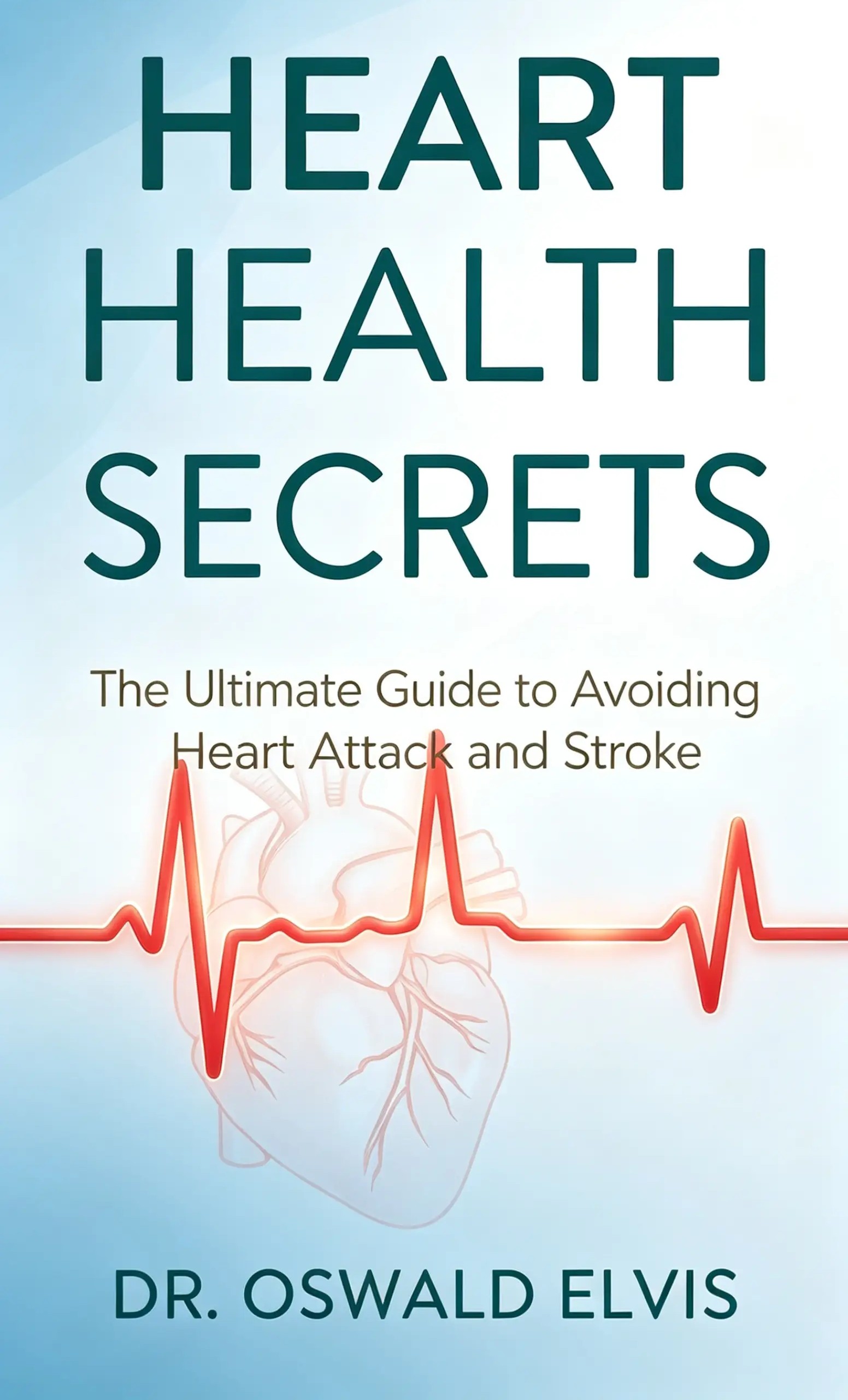
HEART HEALTH SECRETS: The Ultimate Guide to Avoiding Heart Attack and Stroke

Take control of your Heart Health -- without the Fear!
"The Secrets Nobody Told Me"
A Story Leading to Heart Health Secrets: The Ultimate Guide
Part One: The Thing Nobody Mentions
Sarah had always thought she knew her body.
Forty-three years old, relatively fit, ate reasonably well. She went to the gym twice a week. She didn't smoke. Her cholesterol was fine — she'd checked it two years ago at a health fair. She figured she'd dodged the genetic bullet that had taken her father at fifty-two.
She was wrong about almost everything.
The first secret she discovered by accident.
Her smartwatch — a gift from her daughter, something she wore mostly out of obligation — started flagging her resting heart rate. Not dramatically. Just a gentle notification: *"Your resting heart rate is elevated."*
She dismissed it. She was stressed about work. Everyone's heart rate goes up when they're stressed.
But then she noticed something: her resting heart rate never came *down* anymore. Even on weekends, even after a full night's sleep, it hovered at eighty-five, ninety, sometimes higher. Her mother's resting heart rate was sixty-two. Her colleague Marcus's was fifty-eight.
She googled it at midnight the way you do when something small suddenly feels significant.
What she found changed everything.
An elevated resting heart rate — even in someone young and seemingly healthy — was a *predictor*. Not a diagnosis. Just a whisper. A signal that her cardiovascular system was working harder than it should be, day in and day out, like an engine running on high idle.
The articles said things like *"independent risk factor for heart disease"* and *"often overlooked in routine checkups."*
She sat in bed, phone glowing in the dark, and realized the first secret: **nobody had ever told her to pay attention to her resting heart rate.** Not her doctor. Not the health classes in school. Not the wellness programs at her job.
She was supposed to just... know this mattered?
The next morning, she called her doctor.
Part Two: The Whispers
Dr. Patel was thorough in the way that made Sarah understand why some doctors are worth driving forty minutes to see.
*"Your resting heart rate is elevated,"* she confirmed, after checking her watch data. *"But that's one piece of information. Let me ask you some questions."*
The questions seemed random at first.
How was her sleep? *"Fine,"* Sarah said, before pausing. Actually, she woke up most nights. Usually around three. She'd attributed it to age, to hormones, to the general static of middle-aged life.
*"That's not normal,"* Dr. Patel said gently. *"Waking repeatedly can be a sign of sleep apnea, or of your nervous system staying in a constant state of activation. Either way, it stresses your cardiovascular system all night long."*
Sarah felt something shift. A connection being made.
How was her digestion? Her stress levels? Had she noticed any unusual fatigue?
The picture Dr. Patel was drawing wasn't one thing. It was a *pattern* — inflammation, driven by stress, poor sleep, and what turned out to be a diet higher in processed foods than Sarah had realized. Nothing dramatic. Just a quiet, chronic state of her body being at war with itself.
*"You're not sick,"* Dr. Patel said. *"But your body is sending signals. The secret that most people don't know is that heart disease doesn't announce itself with a heart attack. It whispers for years. We just don't know how to listen."*
She ordered bloodwork. Not the standard cholesterol panel Sarah had done two years ago, but deeper markers: inflammation levels, homocysteine, lipoprotein(a), the things that predicted cardiovascular risk but nobody routinely checked.
The results came back a week later.
Sarah's inflammation markers were elevated. Her homocysteine was high. These weren't things that made her sick *today* — they were things that would make her sick in five years, or ten, if she didn't intervene.
*"This is the second secret,"* Dr. Patel said. *"Standard cholesterol numbers tell you almost nothing. You need to know your inflammation status, your blood sugar patterns, your sleep quality. These are the things that actually predict who has a heart attack."*
Sarah sat with that.
She'd been told her cholesterol was fine. She'd thought that meant she was fine.
She wasn't fine. She was just fine *enough* to not notice she was heading somewhere dangerous.
Part Three: The Things That Actually Work
The cardiologist Dr. Patel referred her to — Dr. Reeves — said something that stuck with Sarah.
*"Everyone wants to know what supplement to take, or what diet to follow. But the real secret is this: most heart disease is driven by three things. Sleep. Stress. Movement. Get those right, and everything else usually follows."*
Not medication. Not extreme dieting. Not the things the internet sold you.
Sleep.
Stress.
Movement.
Sarah had been doing none of them well.
She was sleeping five to six hours a night and waking constantly. She was chronically stressed — her job demanded it, and she'd normalized it as just part of being an adult. And her movement was... the gym twice a week for forty minutes, which was something, but it was also performed exercise. It wasn't *living movement* — walking, gardening, taking the stairs, the thousand small activations that kept the body humming.
*"Your nervous system is in constant activation,"* Dr. Reeves explained. *"That's what's driving your elevated heart rate. You need to teach it that you're safe. That takes time, but it works."*
The protocol she recommended felt almost embarrassingly simple:
Eight hours of sleep, non-negotiable. This meant going to bed at ten instead of midnight. It meant saying no to night emails. It meant her nervous system finally getting a chance to actually recover.
Stress management — not meditation apps, though those could help, but actual *changes*. She started saying no to things. She set boundaries around work. She took a walk every morning, not for exercise, but just to be outside, to breathe, to let her nervous system downregulate before the day hijacked it.
Movement throughout the day. Not a workout. Just... living. Taking stairs, parking farther away, standing while on calls, gardening on weekends.
And one more thing Dr. Reeves added: *"Know your family history. Really know it. Your father had a heart attack at fifty-two. That's genetic. That's information. That changes what we monitor for and when."*
Sarah had never connected her father's death to her own risk in a concrete way. It was always *"oh, heart disease runs in the family"* — a vague threat, not a specific instruction.
Now it was both.
*"You have maybe five to seven years before you reach the age where his risk becomes your risk,"* Dr. Reeves said. *"That's not a curse. That's a map. We know exactly what to watch for and when."*
Part Four: The Transformation
Six months later, Sarah barely recognized her own data.
Her resting heart rate had dropped to sixty-eight. Her sleep — actually eight hours now, and uninterrupted — had transformed her energy levels in a way nothing else had. The inflammation markers had dropped significantly. Her blood pressure, which had been creeping up, was now stable.
She'd made almost no dramatic changes.
She'd just listened to what her body had been trying to tell her for years.
But the bigger shift was invisible in the data.
She understood now that she wasn't destined to repeat her father's fate. Genetics wasn't destiny — it was information. It was a specific set of vulnerabilities she could *actively protect against*. She knew what to watch. She knew which markers mattered. She understood that heart disease didn't happen overnight; it was a conversation between her choices and her body, and she finally knew how to have that conversation.
One evening, sitting in her garden — a place she never used to have time for — Sarah thought about all the secrets nobody had told her.
That your resting heart rate mattered more than your cholesterol number.
That inflammation was the real killer, not just fat.
That sleep wasn't a luxury; it was cardiology.
That your family history wasn't a life sentence; it was a blueprint.
That you could actually *prevent* the thing that killed the people you loved.
She pulled out her phone and texted her sister: *"I need to tell you something about Dad, and about what I've learned. Can we talk?"*
Her sister called immediately.
Sarah spent an hour on that call sharing everything — the elevated heart rate, the inflammation markers, the sleep protocol, the movement, the stress management. She gave her sister the same markers to check, the same questions to ask her own doctor.
*"Why is nobody teaching us this?"* her sister said.
*"They are,"* Sarah said. *"We're just not listening. Or we don't know where to listen. That's the real secret — the information exists. We just have to seek it out."*
After they hung up, Sarah realized she'd found her answer to something she'd been wondering for months.
She opened her notes app and began writing.
Everything she'd learned. Every secret that had shifted her trajectory. Every piece of information that had moved her from *"I'm probably fine"* to *"I understand my risk and I'm protecting myself."*
Because the final secret — the one that mattered most — was this:
**The people who survive are the ones who know.**
Not the ones who get lucky.
The ones who *listen*.
Epilogue: What Changed Everything
Three months after Sarah started her transformation, her doctor asked her to come in for an appointment.
*"I want to show you something,"* Dr. Patel said, pulling up her data from a year ago versus now.
The difference was striking. Not just the numbers — though those were compelling — but the trajectory. Sarah wasn't just stabilizing. She was reversing the markers that had been pointing toward disease.
*"If you'd come in a year ago and asked me to predict your cardiovascular health at fifty, I would have been worried,"* Dr. Patel said. *"Now? You're in the category of people who are going to be fine. Better than fine. You've changed the narrative."*
Sarah felt something release in her chest.
Not just relief.
Recognition.
She'd spent her whole life thinking health was something that *happened* to you — genes, luck, the random draw of whether disease found you or not. She'd never understood that it was something you *built*, piece by piece, with information and choices and the willingness to listen to your own body.
The secrets had always been there.
She'd just never been told to look for them.
The Invitation
*If Sarah's story resonates with you — if you've been wondering whether you're actually fine or just fine enough to not notice something dangerous — there's a path forward.*
**Get the full guide: "Heart Health Secrets: The Ultimate Guide to Avoiding Heart Attack and Stroke"**
*In this ebook, you'll discover:*
- The markers your doctor might be missing (and how to ask for them)
- Why your resting heart rate matters more than your cholesterol
- The sleep protocol that reverses cardiovascular inflammation
- How to decode your family history as a map, not a curse
- The movement strategy that actually prevents disease
- How to catch the whispers before they become screams
*Your father's fate doesn't have to be your future.*
**Download "Heart Health Secrets" today and start listening to what your body has been trying to tell you.**
GET INSTANT ACCESS:
Download your copy now and start protecting your heart today!
BUY NOW/ GET INSTANT ACCESS!!
PRICE: $9 Only
FREQUENTLY ASKED QUESTION
A. Who is this book for?
The USA, Nigerians, UK citizens, Nigerians in the UK, & USA, students, young adults, and small business owners who want practical, no-fluff advice on preventing heart attack and stroke. If you're busy and don't have time to read medical journals, this is for you.
B. Is this a medical Advice?
No. Heart Heart Secrets explains common risk factors, warning signs, and lifestyle changes linked to heart health in plain language. It's educational, not a substitute for a doctor. Always consult your GP for personal medical concerns.
C. What makes this different from free info online?
The book pulls together the most relevant causes, early warning signs, diet, exercise, stress, and willpower strategies into one clear guide. No jargon, no conflicting articles, just steps you can act on immediately.
D. When and How will I get the book?
The book is already available digitally on Selar. Physical copies will be arranged if we hit the stretch goal. You'll get instant download access once you purchase.
E. Can i support without buying the Book?
YES. Sharing the campaign, tagging friends who need it, and engaging with the free health tips on my TikTok all help reach more people.