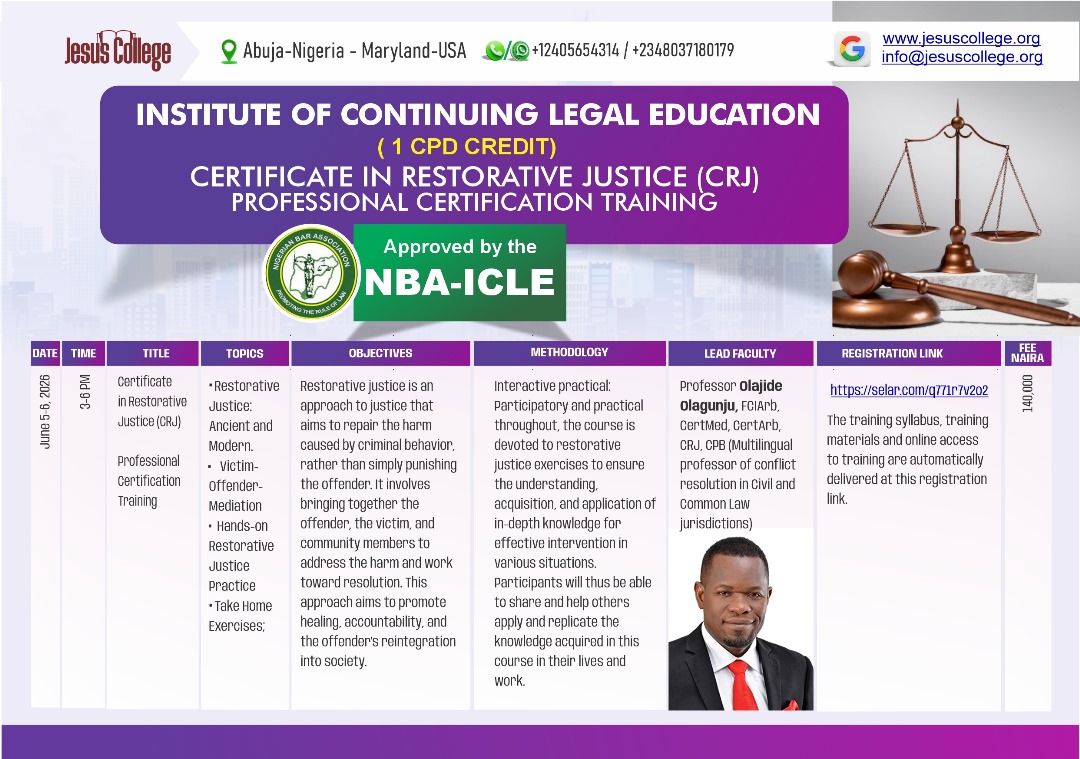
Certificate in Restorative Justice (CRJ) Training June 19-20, 2026 (FREE REGISTRATION FOR JUDGES & STATE COUNSEL)

Get Tickets
Total Admissions: 0CERTIFICATE IN RESTORATIVE JUSTICE
(CRJ)
COURSE SYLLABUS
Course Number
CRJ101
Course Title
RESTORATIVE JUSTICE COURSE
Course Description
Restorative justice is an approach to justice that focuses on repairing the harm caused by criminal behavior, rather than just punishing the offender. It involves bringing together the offender, the victim, and members of the community to address the harm and work towards a resolution. This approach seeks to promote healing and restitution for the victim and accountability, reformation and reintegration for the offender into society, while restoring the peace of the entire community affected by the infraction.
Conflict resolution, which is at the heart of restorative justice is arguably the largest industry in the world. This is because, like food and air, conflict is inevitable and all-pervasive. This course assists each course participant to understand the phenomenon of conflict in-depth. We shall also study principles, practice and procedure in conflict resolution. The goal is to assure that each participant clearly understands, deeply appreciates and holistically engages the phenomenon of conflict with reference to restorative justice practice.
Participatory and hands-on all through, a substantial part of the course is allocated to restorative justice exercises to ensure the understanding, acquisition and application of confident fingertips knowledge for effective intervention in diverse situations.
This 50-hour training is designed for leaders and aspiring leaders in all spheres of life. Participants will therefore be able to impart and help others to apply and replicate the knowledge gained in this course in their lives and work. The successful participant is awarded the Certificate in Restorative Justice (CRJ), which they can add after their name to show they are professionally trained restorative justice practitioner.
Academic Credit(s) 1
The requirements for completion of the CRJ training are:
1. Participation in class.
2. Interaction with other participants.
3. Participation in restorative justice exercises.
4. Two (2) book reviews (250 words each) of the following two (2) reading materials:
(a) - Marshall T. 1999. Restorative Justice: An overview:
http://www.antoniocasella.eu/restorative/Marshall_1999-b.pdf;
(b) Olagunju, O. (2026). Global History of Restorative Justice: A Comprehensive Study of Origins, Development, and Cultural Evolution. ResearchGate. https://www.researchgate.net/publication/403232040_Global_History_of_Restorative_Justice_A_Comprehensive_Study_of_Origins_Development_and_Cultural_Evolution
5. 500-word Journal documenting knowledge and lessons acquired/learnt in the course; and a plan to apply them after the training.
EMAIL ALL ASSIGNMENTS TO: [email protected]
2 Nos. Book Reviews 20%
500-word Journal documenting knowledge and lessons acquired/learnt in this training; and a plan to apply them after the training 20%
Interaction with other participants 10%
Restorative Justice Exercises 20%
Class attendance 30%
TOTAL 100%
READINGS
Readings:
1. Barton C.K. 2003. Restorative Justice - The Empowerment Model. ASIN: B01FGJTLIQ
2. Bontrager W. 2024. A Biblical Approach to Restorative Justice. Jesus College, Maryland-USA
3. Braithwaite J. 1989. Crime, Shame and Reintegration. Cambridge University Press. ISBN: 978-0521356688
4. Fisher R, Ury W, Patton B. 2011. Getting to Yes: Negotiating Agreement Without Giving In. Penguin Books. ISBN: 978-
0143118756;
5. Jesus College Maryland USA. (2024). Restorative Justice & Victim Offender Mediation Webinar, [Video],:
https://www.youtube.com/watch?v=02bHsWYbN8s
6. Jim Consedine. 1999. Restorative Justice: Healing the effect of crime. Ploughshares Publications. ISBN: 978-0473029920
7. Jim Consedine and Helen Bowen. 1999. Restorative Justice: Contemporary themes and practices. Ploughshares Publications.
ISBN: 978-0473056575
8. Marshall T. 1999. Restorative Justice: An overview. Home Office Research Development and Statistics Directorate: http://www.antoniocasella.eu/restorative/Marshall_1999-b.pdf
9. Olagunju O. (2020). How to Resolve a Conflict: Principles, Practice and Procedure in Conflict Resolution - The Mediator's Handbook. Corporate Mediators. ISBN: 979-8590092307https://www.barnesandnoble.com/w/how-to-resolve-a-conflictolajide-olagunju/1144536810?ean=9798855690798; OR:
10. Olagunju O. 2021. How to Resolve a Conflict. YouTube. 80-Part Audio Video Lecture Series: https://www.youtube.com/playlist?list=PLtkSf-8tsffgOY5mYeXCFhnmc6Kr0pVqt
11. Olagunju O. 2024. Mediation As the Pathway to Dispute Resolution, Not an Option.
https://jesuscollege.org/mediation-as-the-pathway-to-dispute-resolution-not-an-option/
12. Olagunju, O. (2026). Restorative Justice in Civil Disputes: Principles, Practice, and Prospects - A Comprehensive Analysis for Legal Professionals, Mediators, and the Public. ResearchGate. https://www.researchgate.net/publication/403332620_Restorative_Justice_in_Civil_Disputes_Principles_Practice_and_Prospects_-_A_Comprehensive_Analysis_for_Legal_Professionals_Mediators_and_the_Public
13. Olagunju, O. (2026). Global History of Restorative Justice: A Comprehensive Study of Origins, Development, and Cultural Evolution. ResearchGate. https://www.researchgate.net/publication/403232040_Global_History_of_Restorative_Justice_A_Comprehensive_Study_of_Origins_Development_and_Cultural_Evolution
14. Olagunju, O. (2026). African Roots of Restorative Justice: Foundations, Global Influence, and Enduring Relevance (An Exploration of African Dispute Resolution and Its Impact on Contemporary Restorative Justice). ResearchGate. https://www.researchgate.net/publication/401822674_African_Roots_of_Restorative_Justice_Foundations_Global_Influence_and_Enduring_Relevance_An_Exploration_of_African_Dispute_Resolution_and_Its_Impact_on_Contemporary_Restorative_Justice
15. Omale D. J. 2006. Justice in History: An Examination of the African Restorative Traditions and the Emerging Restorative Justice Paradigms. https://www.umes.edu/uploadedFiles/_WEBSITES/AJCJS/Content/vol2%202%20omale%20final.pdf; OR https://www.researchgate.net/publication/326265660_JUSTICE_IN_HISTORY_AN_EXAMINATION_OF'AFRICAN_
RESTORATIVE_TRADITIONS'_AND_THE_EMERGING_'RESTORATIVE_JUSTICE'_PARADIGM/link/5cd2cca8a 6fdccc9dd93ccbc/download?_tp=eyJjb250ZXh0Ijp7ImZpcnN0UGFnZSI6InB1YmxpY2F0aW9uIiwicGFnZSI6InB1Ym xpY2F0aW9uIn19
16. Omale D. J. 2012. Restorative Justice and Victimology: Euro-Africa Perspectives. Wolf Legal Publishers. ISBN: 978-
9058508614
17. Ross R. 2003. Returning to the Teachings: Exploring the Aboriginal Justice. Penguin Books Canada. ISBN: 9780140258707
18. Sande, K. 2004. The Peacemaker: A Biblical Guide to Resolving Personal Conflict. Baker Books. ISBN: 978-0801064852.
19. Zehr H. 1990. Changing Lenses: A new focus for crime and justice. Herald Pr. ISBN: 978-0836135121
20. Zehr, H. (2015). The Little Book of Restorative Justice. Good Books. ISBN: 978-1561488230.
Course Outline
DAY 1: Interactive conceptualization
Day 2: Practical exercises
©2025 Jesus College Maryland-USA ([email protected])