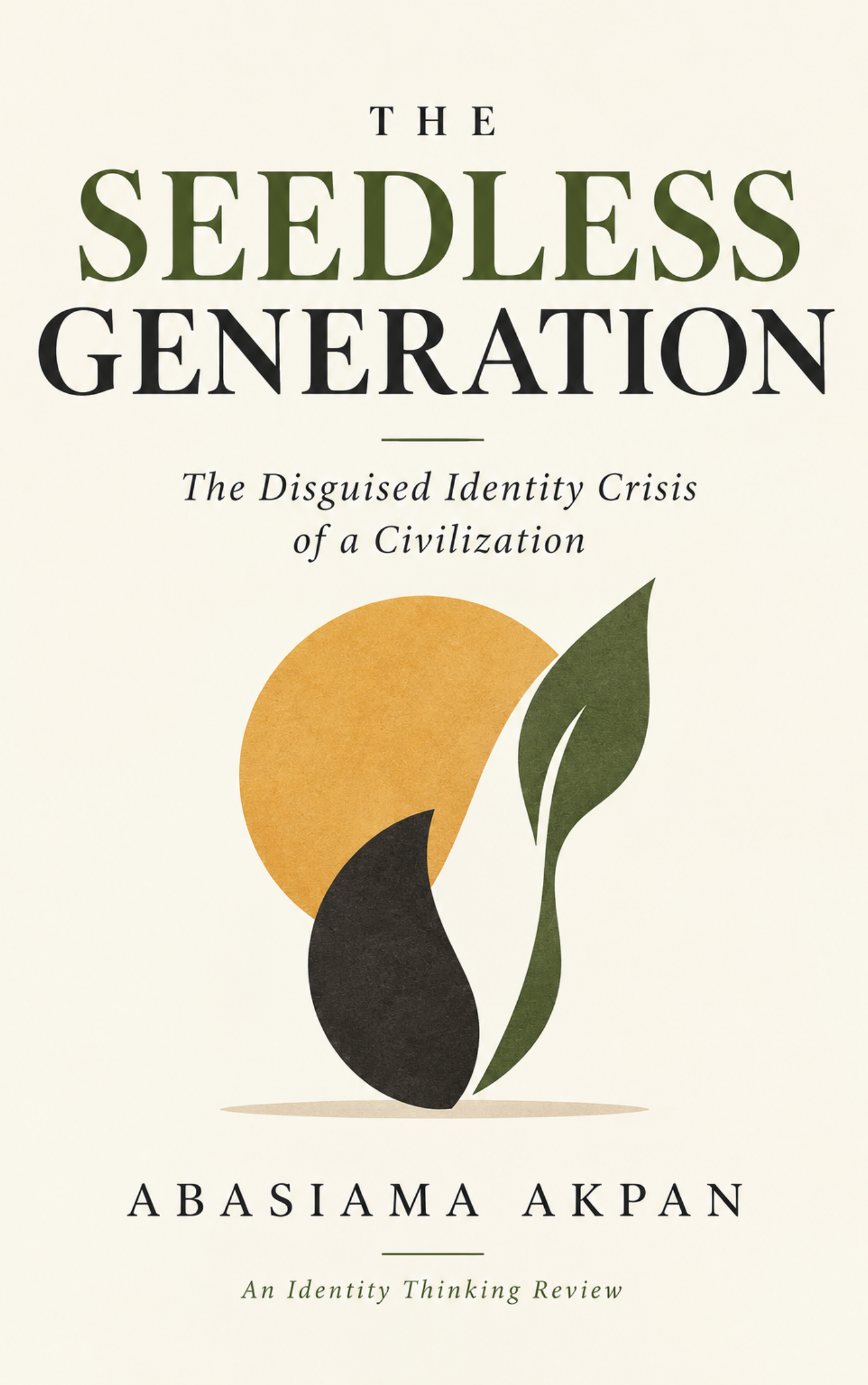
THE SEEDLESS GENERATION: The Disguised Identity Crisis of a Civilisation

Why are entire nations now paying their own citizens to have children — and quietly losing that fight? Why is meat now grown in a bioreactor with no animal, no mother, and no life cycle behind it? Why does a generation raised on more connection than any before it feel less able to pass down a name, a language, or a faith?
The Seedless Generation argues these are not three separate stories. They are one story, told three times.
Using the Identity Spectrum — Original, Adaptive, Abnormal Adaptive — this Identity Thinking Review reads demographic collapse, the battle over seed and food ownership, and the ancient pattern of Babel as a single civilizational drift: a world that has grown extraordinarily good at producing outcomes while losing its grip on what makes those outcomes reproduce themselves. Fruit without seed. Production without a future.
For policy audiences, this book names something most demographic strategy still won't say out loud: across roughly fifty-five nations now running pronatalist policy — interest-free family loans, maternity capital, baby bonuses, fertility-treatment subsidies — the money has consistently failed to move the outcome it was spent on. This book documents that record case by case, and argues why: fertility decline is not fundamentally an economic problem, so no economic instrument, however well-funded, resolves it alone. For anyone advising a government, a foundation, or an international body on demographic or family policy, this book supplies the missing variable current strategy keeps working around — and the vocabulary to name it in a room that has run out of budget-based answers.
This is not a book that resolves the tension it names. It is a book that insists you see it — clearly, honestly, and without the comfortable distance of "someone else's problem" — before asking what you intend to plant.
What's inside:
- A documented case-by-case record of national pronatalist policy — Hungary, Poland, Russia, Singapore, South Korea, Japan, China — and why financial incentive alone has not reversed a single one of these trajectories
- The historical and biblical record of civilizations that didn't merely decline, but ceased to exist — from Sodom and Gomorrah to Sparta's oliganthropia
- The loss of a mother tongue as its own form of seedlessness, traced through Africa's own colonial history
- A firm reading of cultivated meat and human cloning through the same spectrum — where Scripture's silence on manufacturing life outside its designed pattern becomes the book's clearest verdict
- Babel and Pentecost read as a single argument about sameness, particularity, and the image of God
- 23 sections, each closing with Seed Thoughts — discussion-forcing questions built for personal reflection, book clubs, church small groups, and policy roundtables alike
Who this is for: Christian intellectuals and pastors wrestling with meaning and family in their congregations; identity coaches and educators; and public policy consultants, demographers, and development professionals looking for the language current frameworks don't yet have — for problems money and policy keep failing to solve alone.
You will not finish this book with every question answered. You will finish it unable to un-see what it names.