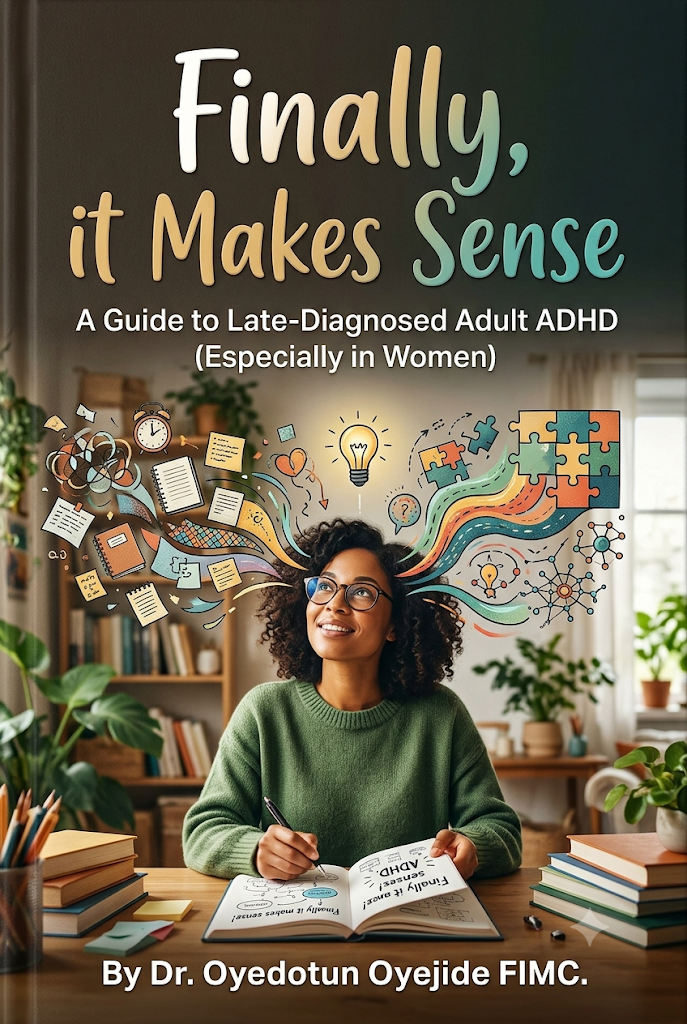
Finally, It Makes Sense : A Comprehensive Guide to Late- Diagnosed Adult ADHD, Especially in Women

Finally, It Makes Sense
A Comprehensive Guide to Late- Diagnosed Adult ADHD, Especially in Women
By Dr. Oyedotun Oyejide, FIMC
You Were Never Lazy. You Were Never "Just Anxious." You Were Never "Bad at Adulting."
You Were Undiagnosed — And It's Not Too Late to Finally Make Sense of It.
THE JOURNEY OF MEANING AT LAST….WHO IS THEN WISER?
You've spent years being the one who's always late. The one who starts ten projects and finishes three. The one who was told, by teachers, by doctors, by your own inner voice that you just needed to try harder.
Then one day — a friend's offhand comment, your own child's diagnosis, a video you weren't even looking for — you see a description of ADHD that doesn't match the
Hyperactive-boy stereotype at all. It matches you. Exactly you.
Here's what almost nobody told you: ADHD in women looks different, and for decades, the diagnostic system was built almost entirely around a presentation that isn't yours. That's not a personal failing. That's a well-documented gap — and it's why so many women don't get diagnosed until 30, 40, or later.
THE PROBLEM (naming it precisely)
Here's what usually happens, and almost nobody has the language for
It in the moment:
You were the "quietly scattered" kid, not the disruptive one, so nobody ever suspected ADHD.
You were diagnosed with anxiety, or depression, or both — treatment helped a little, but something always stayed unaddressed.
You built exhausting, invisible systems just to appear "normal," and now you're burnt out from a struggle no one around you ever saw.
Small criticism at work sends you into a spiral you can't explain, even to yourself.
You know exactly what you need to do — and you still can't make yourself start.
None of this means you're broken. It means your brain works differently, in a well-documented, treatable way
— And you were never given the chance to understand it.
THE TURN Yes,….there's a way through)
Finally, It Makes Sense is a comprehensive, research-grounded guide built specifically for women diagnosed with ADHD after 30 — or women who suspect they should be.
THERE WILL ALWAYS BE A SHADOW AFTER EVERY CHANNEL IN LIFE
NO HOPE IS LOST…….
Drawing on the published research of Dr. Russell Barkley on executive function, Dr. Ellen Littman and Dr. Patricia Quinn on women and ADHD, and Dr. Stephen Hinshaw's landmark longitudinal studies following girls with ADHD into adulthood, this book gives you real answers — not vague self-help platitudes.
WHAT'S INSIDE:
Part One — Understanding What Happened
What ADHD actually is, beyond the
Stereotype. Why it looks so different in women — and why the diagnostic system missed you. The masking
Phenomenon: how you learned to hide it, and what that's actually cost you. Why so many women get misdiagnosed with anxiety or depression instead. How hormones affect symptom severity across your cycle, pregnancy, and per menopause. And the honest, full weight of what late diagnosis costs
— named directly, not minimized.
Part Two — Making Sense of It Now How to get an accurate adult evaluation. Grieving and reframing your own history through a new, more accurate lens. Rejection Sensitive Dysphonia — the emotional piece almost nobody warns you about. Why executive function, not willpower, was always
The real issue. Time blindness, sensory overwhelm, and an honest, research-grounded look at medication and therapy. And real systems for daily life, built for your actual brain.
Part Three — Living Well With Late- Diagnosed ADHD
Advocating for yourself at work and finding real fit. Communicating with partners and family so old patterns stop being misread as carelessness. Parenting with ADHD, including the common path of recognizing yourself in your own child's diagnosis. Building a real support system. And rewriting the inner critic that's been running the show for years.
Plus, a full workbook:
An executive function self- inventory
A symptom & cycle tracker An evaluation and doctor-visit prep worksheet
A weekly self-check-in
A strengths & values inventory
10 ready-to-use conversation scripts
A glossary of every term used in the book
Guided journal pages
WHO THIS IS FOR?
Women who suspect they have ADHD but have never been
Formally evaluated
Women previously diagnosed with anxiety or depression whose treatment never fully resolved things
Women diagnosed after their own child's ADHD diagnosis Anyone tired of "just try harder" advice and ready for real,
Research-backed understanding
WHO THIS ISN'T FOR?
This is not a diagnostic tool, and it's not a substitute for a comprehensive clinical evaluation. It won't diagnose you — what it will do is prepare you to recognize your own patterns clearly and advocate
For yourself effectively when you do seek an evaluation.
THE PROMISE (honest, not hyped)
We won't tell you this book will fix everything overnight, or that understanding alone resolves years of executive function difficulty. It won't.
What we will give you: the accurate, complete picture that should have been available to you decades ago
— The real research, the real vocabulary, and the real, practical tools to finally stop fighting yourself
And start building a life that works with your brain, not against it.
SOCIAL PROOF PLACEHOLDER
"I cried reading Chapter 3. Masking had a name this whole time and I never knew it." — [Wale James)
THE OFFER:
Finally, It Makes Sense: A Comprehensive Guide to Late- Diagnosed Adult ADHD, Especially in Women
By Dr. Oyedotun Oyejide, FIMC
90 pages. Instant PDF download. Read on any device.
[BUY NOW BUTTON — $[PRICE]]
Instant access. Start finally making sense of it tonight.
FAQ (objection handling)
"I've never had a formal evaluation
— is this book still useful?"
Yes — it's designed to help you recognize patterns worth exploring, and includes a full evaluation-prep worksheet for when you're ready to pursue one.
"I was already diagnosed with anxiety or depression. Could this
Still apply to me?"
Very possibly — Chapter 4 covers this exact, extremely common pattern directly.
"Will this tell me to just go on medication?"
No. Chapter 13 gives an honest, balanced look at medication, therapy, and coaching, so you can have an informed conversation with your own prescribing clinician — not follow a blanket recommendation.
"I don't match the 'hyperactive' ADHD stereotype at all — does this still apply to me?"
Yes — this book is built specifically around the inattentive, internally- experienced presentation far more
Common in women, which almost never matches the popular stereotype.
"Is this too clinical or dense to actually read?"
No — it's written in plain, direct, compassionate language, organized so you can read cover to cover or jump straight to the chapter most relevant to you right now.
CLOSING
You were never lazy. You were never too much, or not enough. You were someone whose brain was never
Given the understanding it deserved.
It's not too late. Finally, it makes sense.
[BUY NOW — Get Instant Access]