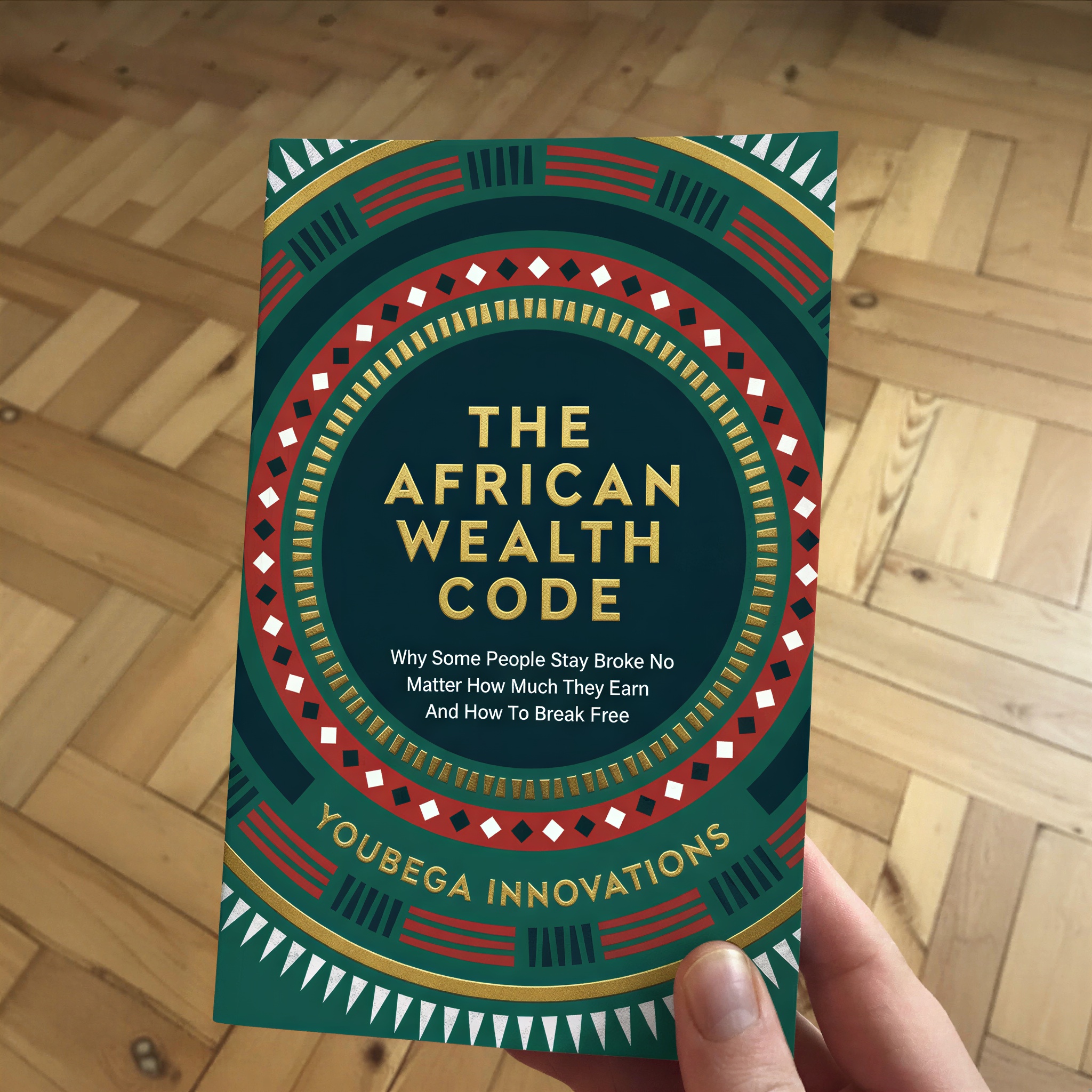
THE AFRICAN WEALTH CODE Why Some People Stay Broke No Matter How Much They Earn And How To Break Free

You have been earning. Every month, consistently, honestly. And the account still does not reflect it.
You have tried the budget. You have made the promise to yourself at the beginning of every new month. You received the raise, switched jobs, landed the contract, and watched the money settle into the same thin margin it always settles into by month end.
The problem is not that you earn too little. The problem is that the way you think about money was written into you before you were old enough to question it. And it has been running quietly ever since.
The African Wealth Code is not a book about which platform to invest on or what percentage to put aside. It is a specific examination of the psychological patterns that determine whether any savings plan, any budget, or any investment strategy gets used consistently or quietly abandoned. It is for the African earner who has already tried the systems and wants to understand why the systems keep failing.
INSIDE THIS BOOK
💸 Why Your Income Has Never Fixed the Problem
You will understand the specific mechanism that causes expenses to expand and absorb every salary increase, leaving you in the same financial position regardless of what you earn. The research behind it is documented. The solution is structural, not motivational.
🧠 The Childhood Beliefs That Are Running Your Finances Right Now
Financial psychologist Brad Klontz's research shows that money beliefs formed in childhood predict adult financial behavior more powerfully than income or education. You will locate the specific beliefs installed in your household, identify how they are shaping your decisions today, and begin the work of revising them.
⚔️ Why Your Budget Fails Every Single Time
Roy Baumeister's research on willpower depletion explains precisely why every budget system you have attempted has eventually collapsed, and why the problem has nothing to do with your discipline. You will understand what actually sustains financial behavior change and how to build it.
💡 The Family Tax and What It Is Actually Costing You
Research across West African households documents what economists call the family tax: a financial transfer mechanism that scales with your perceived income and carries no natural ceiling. You will see the structural problem clearly and learn how to restructure your giving so it no longer prevents you from building anything of your own.
🛡️ How Social Pressure Overrides Your Financial Judgment
Robert Cialdini's research on social influence explains why you consistently say yes to financial obligations even when you know the cost. You will learn to build specific permission structures that hold under actual pressure rather than collapsing in the moment of decision.
📈 The Exact Lifetime Cost of Your Status Spending
Drawing from Thomas Stanley's research in The Millionaire Next Door and Tim Kasser's work on materialism, this section shows you what the premium choices made for appearance rather than function are compounding to over ten and twenty years. The number is specific. It is larger than most people expect.
🔥 Why Wealth Accumulation Feels Psychologically Dangerous
Brad and Ted Klontz's research on money disorders explains why some earners unconsciously spend down every financial gain they make, including the specific African cultural patterns around envy and first-generation wealth that make this pattern more common here. If your savings seem to have a ceiling they never cross, this chapter names what is operating below it.
🎯 The Urgency Trap and How It Is Being Used Against You
Hyperbolic discounting is the psychological reason Ponzi schemes keep finding participants across Africa and why the instinct to need results immediately destroys long-term wealth building. You will understand the mechanism and learn what research on future self-continuity shows about building genuine financial patience.
📘 Five Specific Practices That Actually Change the Pattern
Drawing from Richard Thaler's nudge theory, James Clear's identity research, and Prochaska's stages of change, this section gives you five sequenced, research-backed practices for rewriting your financial code at the level where it actually operates, not at the level of spreadsheets and good intentions.
WHAT MAKES THIS BOOK DIFFERENT
Most money books written for African audiences focus on financial products: which platform to use, which account to open, which percentage to set aside. This book works one level deeper, at the psychology that determines whether any of those products ever get used consistently. You have already had several systems. This book examines why none of them held, using specific behavioral research applied directly to the African financial and cultural context. No general self-help title does that work.
BENEFITS YOU'LL NOTICE
📌 The ability to receive a salary increase and make a deliberate structural decision about where it goes before lifestyle inflation absorbs it
📌 Reduced internal conflict when declining social financial obligations because the boundary was prepared in advance rather than improvised under pressure
📌 A clear identification of at least one childhood money belief that has been shaping your financial decisions without your awareness
📌 Less anxiety when savings begin to accumulate because the pattern behind unconscious wealth sabotage is named and no longer invisible
📌 At least one automated financial behavior running without your involvement before the end of the first month after reading
📌 The specific words you will use the next time a family financial request arrives that you cannot afford to meet
I wrote this book for the person who has done the right things and still cannot close the gap. The behavioral research in these pages is real. The cultural specificity is intentional. The African financial context is not an afterthought here. It is the entire point.
— Author
WHO THIS BOOK IS FOR
- For the professional earning a real income every month who has nothing meaningful saved and cannot explain the gap
- For the first-generation earner who is supporting an entire family network and building nothing personally
- For the person who has tried every budget system available and watched each one eventually fail
- For the earner who receives a raise and finds it absorbed within three months without any visible improvement in their financial position
- For anyone who has said yes to a social financial obligation they could not afford and could not explain why they said yes anyway
- For the person who suspects the problem is deeper than any savings app can reach
FROM HERE TO THERE
From earning and spending to earning and owning
From giving everything away today to building something that outlasts you
From running other people's financial scripts to writing your own
From managing anxiety with money to building security with it
From the performance of wealth to the quiet reality of it
👉🏽 Click "I Need A Copy" and begin reading the code that has been running your finances since before you understood what finances were.