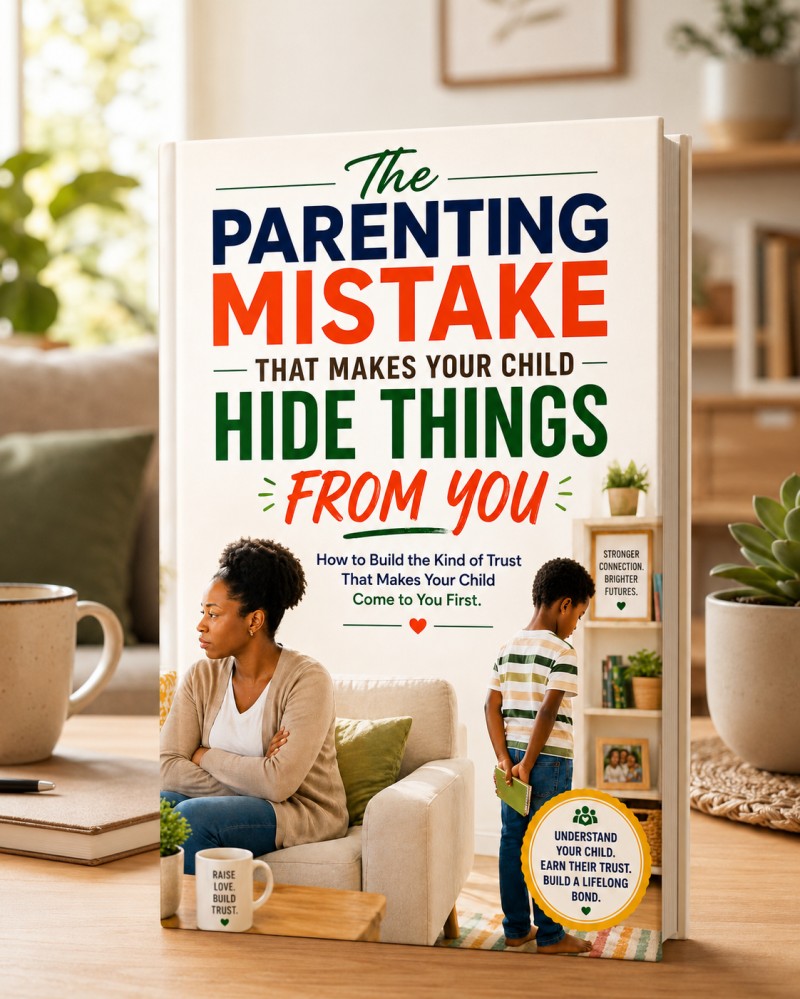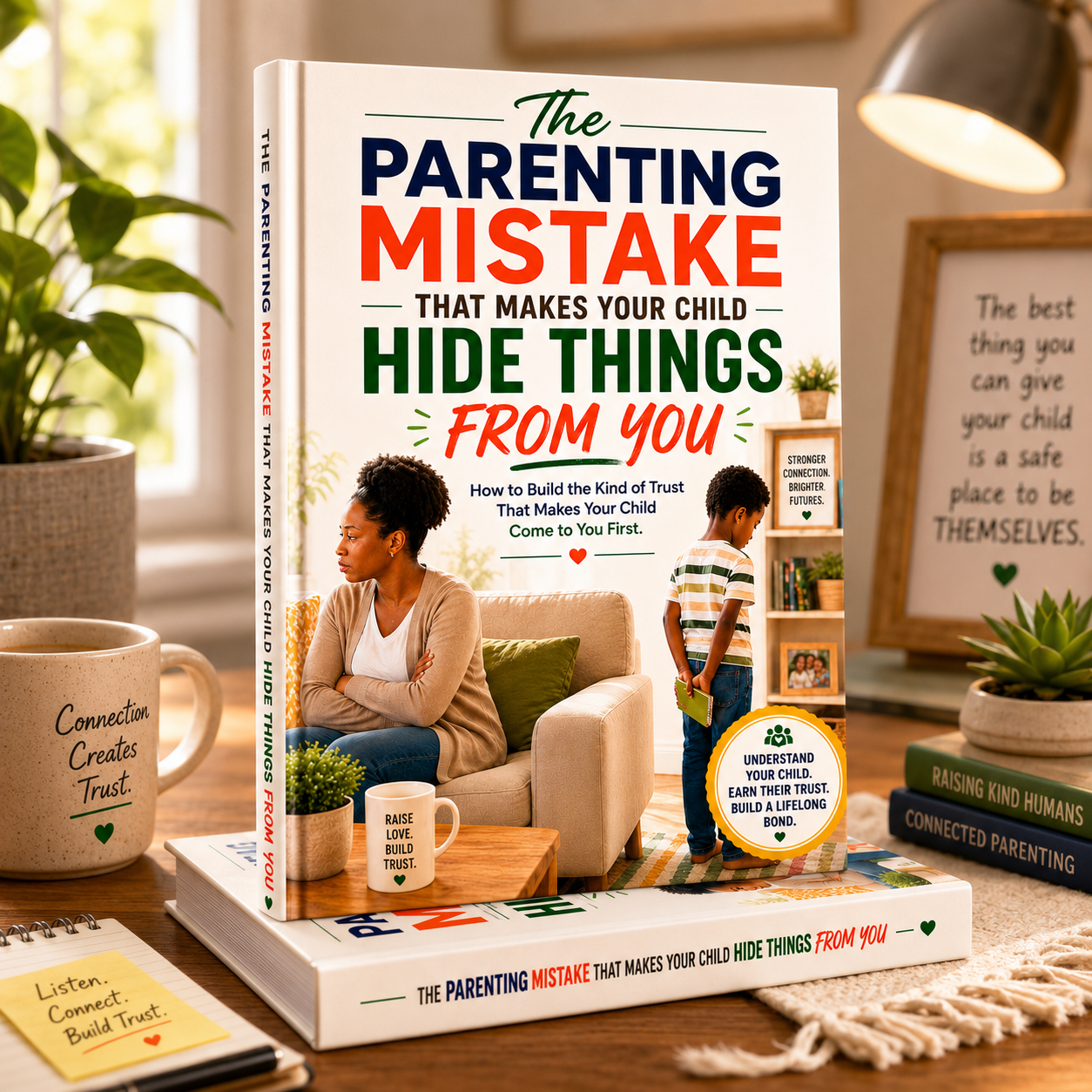
The Parenting Mistake That Makes Your Child Hide Things From You

Your child is not hiding things because they are “bad.”
Most times, they are hiding because they are afraid of the reaction that may follow the truth.
And without realizing it, many of us as African parents unknowingly teach our children to become careful instead of open.
Not through hatred, not through bad intentions.
But through the parenting patterns many of us inherited and normalized growing up.
Over time, your child quietly learns something heartbreaking:
“It is safer to hide than to be honest.”
So instead of coming to you when they are struggling…
They hide mistakes.
Hide relationships.
Hide addictions.
Hide mental health struggles.
Hide pain.
Not because they don’t love you.
But because they don’t feel emotionally safe enough to be fully honest.
And this book will help you understand why that happens — and how to rebuild the kind of trust that makes your child open up again.
This is not a book about blaming parents. It is a guide to helping you reconnect with your child before silence becomes distance.
You Love Your Child Deeply, But love alone does not always create openness.
There is a difference between a child who obeys you and a child who trusts you.
A child who obeys you will behave when you are watching.
But a child who trusts you will come to you when they are struggling — before they turn to strangers online, friends, or harmful influences.
Sadly, many African parents were taught how to enforce obedience, but never taught how to build emotional safety.
This book will help you raise a child who not only respects you, but also feels safe enough to tell you the truth — Without losing your authority, without abandoning your values, and without becoming a "soft" parent who lets their child do whatever they want.
What You Will Get Inside This Book:
📖 The real reason your child has stopped telling you things — and how it happened without either of you noticing
📖 A clear picture of your child's hidden world — what they share with friends, what they do online, and who they actually go to when something goes wrong
📖 The exact words and phrases that shut children down — and what to say instead to keep the door open
📖 A step-by-step framework for building genuine trust — not compliance, not performance, but real, lasting trust
📖 How to have the conversations most African parents avoid — relationships, sex, money, failure, faith, and peer pressure — without losing your authority
📖 A proven approach to discipline that corrects behaviour without damaging the relationship
📖 Practical tools for repairing a relationship that has already grown distant — even if the silence has been going on for years
📖 How to raise a child who is emotionally strong, honest, and able to handle whatever life brings them
📖 A ready-to-use letter template for the parent who wants to begin the work of repair but does not know how to start
This Book Is For You If…
✅ Your child says "I'm fine" every time you ask how they are — and you know something is off
✅ You find out about problems in your child's life from other people, not from them
✅ You had a strict upbringing and you are not sure how to parent differently without feeling like you are losing control
✅ You feel close to your child on the surface, but you sense there is a whole part of their life you are not seeing
✅ You have a teenager who has gone quiet — and you do not know how to reach them anymore
✅ You want your child to choose to come to you first — not because they have to, but because they genuinely trust you
✅ You are ready to do the work — not just read about it, but actually change how things are at home
What Makes This Different From Every Other Parenting Book
Most parenting books are written for Western families. They assume a context that does not match your reality — your culture, your pressures, your family structure, your values.
This book was written with the African parent in mind.
It does not ask you to abandon your culture. It does not tell you to stop being strict or to let your child run wild. It does not pretend that respect is not important or that discipline is wrong.
It simply shows you that the way you express love and authority — right now, as things are — may be creating exactly the silence you are afraid of. And it shows you, step by step, how to change that.
The examples are African. The language is direct. The approach is honest.
No fluff. No judgment. No Western framework imposed on an African family.
Just the truth — and a clear path forward.
A Word From the Pages of This Book
"A child who respects you out of fear will comply. A child who respects you out of connection will confide. There is a world of difference between the two — and the difference shows up most clearly in a crisis."
"Every time your child tells you something difficult and you respond with curiosity rather than judgment, you make a deposit into the account of trust. Enough deposits, and the account becomes rich enough to survive the withdrawals that will inevitably come."
What Parents Are Saying
"I cried reading Chapter 3. My mother said those exact words to me and I heard myself saying them to my daughter. I ordered this and read it in two days. Things are already different in our house." — Chioma A., Lagos
"My teenage son and I barely spoke for two years. After reading this book and trying the approach in Chapter 10, he called me — just to talk. First time in a long time. I cannot explain what that felt like." — Emmanuel K., Accra
"This is the book I wish my father had read. I am sending it to my sister too. Every African parent needs this." — Aisha M., Nairobi
"I was defensive at first because I thought it was going to attack how I was raised. It didn't. It just showed me what I was missing. Very well written and very real." — Dr. Tunde O., Abuja
What Happens If Nothing Changes?
Your child is growing up. Every year, the window to build real trust gets a little smaller.
At 8, they still need you.
At 13, they are choosing whether to need you.
At 18, that choice has largely been made.
The parents who are not in their adult children's lives did not lose that relationship at 25. They lost it at 11 — one silence at a time, one dismissed feeling at a time, one shut door at a time.
You do not have to be that parent.
Get The Book Now
The door between you and your child is still open. This book shows you how to walk through it.
👉 Click on "I Need This Book" botton above to get the book now ❤️