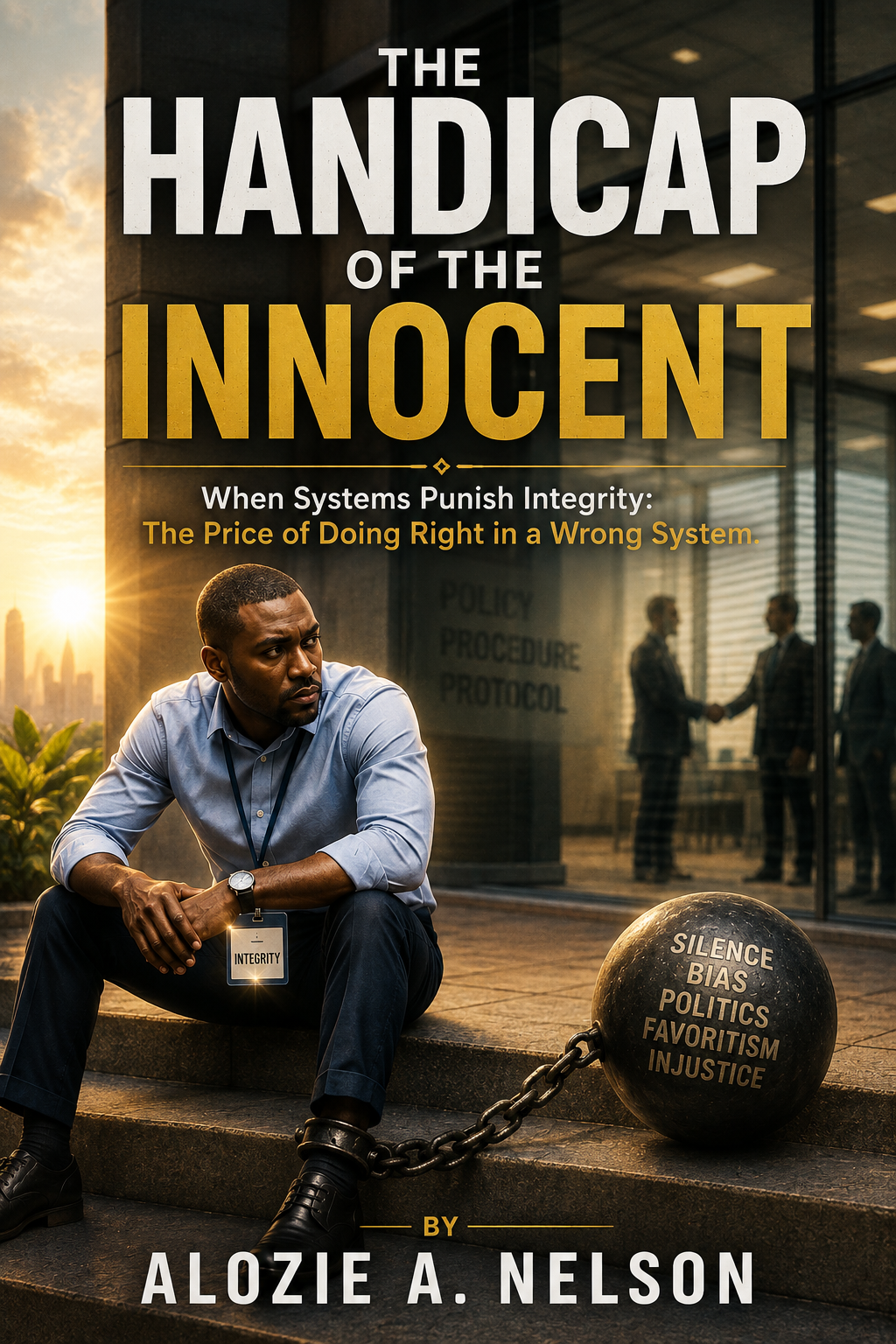
THE HANDICAP OF THE INNOCENT When Systems Punish Integrity: The Price of Doing Right in a Wrong System. By ALOZIE A. NELSON

THE HANDICAP OF THE INNOCENT
When Systems Punish Integrity: The Price of Doing Right in a Wrong System
What happens when a person enters a system believing that integrity, competence, loyalty, and hard work will be recognized—only to discover that the system rewards something else?
The Handicap of the Innocent explores one of the quiet contradictions of modern institutional life: the possibility that people who do the right things can become disadvantaged precisely because the systems around them do not consistently reward what they claim to value.
In workplaces, governments, organizations, and societies, power does not always operate openly. Sometimes it hides behind procedure, hierarchy, silence, policy, reputation, and administrative discretion. Merit can become secondary to proximity. Integrity can be mistaken for weakness. Silence can be rewarded as professionalism. And those who refuse to manipulate the system may find themselves carrying a burden they did not create.
But the innocent is not necessarily naïve, weak, or incapable. The innocent may simply be a person who trusts that declared principles correspond with actual practice.
This book examines the Age of Administrative Cunning—an environment in which institutional advantage can be created through strategic positioning, selective recognition, controlled narratives, and the quiet manipulation of systems. Yet the answer is not to become cunning.
It is to become aware without becoming corrupt. Through the idea of Principled Intelligence, Alozie A. Nelson explores how individuals can understand power, develop strategic awareness, protect their conscience, and pursue advancement without surrendering their moral identity.
The book ultimately asks a difficult question:
How can a person survive an imperfect system without becoming a product of its imperfections?
The Handicap of the Innocent is a reflection on power, integrity, workplace hierarchy, institutional injustice, responsibility, conscience, and the possibility of building systems where fairness is not merely promised—but structurally protected.
Because sometimes the greatest handicap is not a lack of ability. It is doing right in a system that has learned to reward something else.