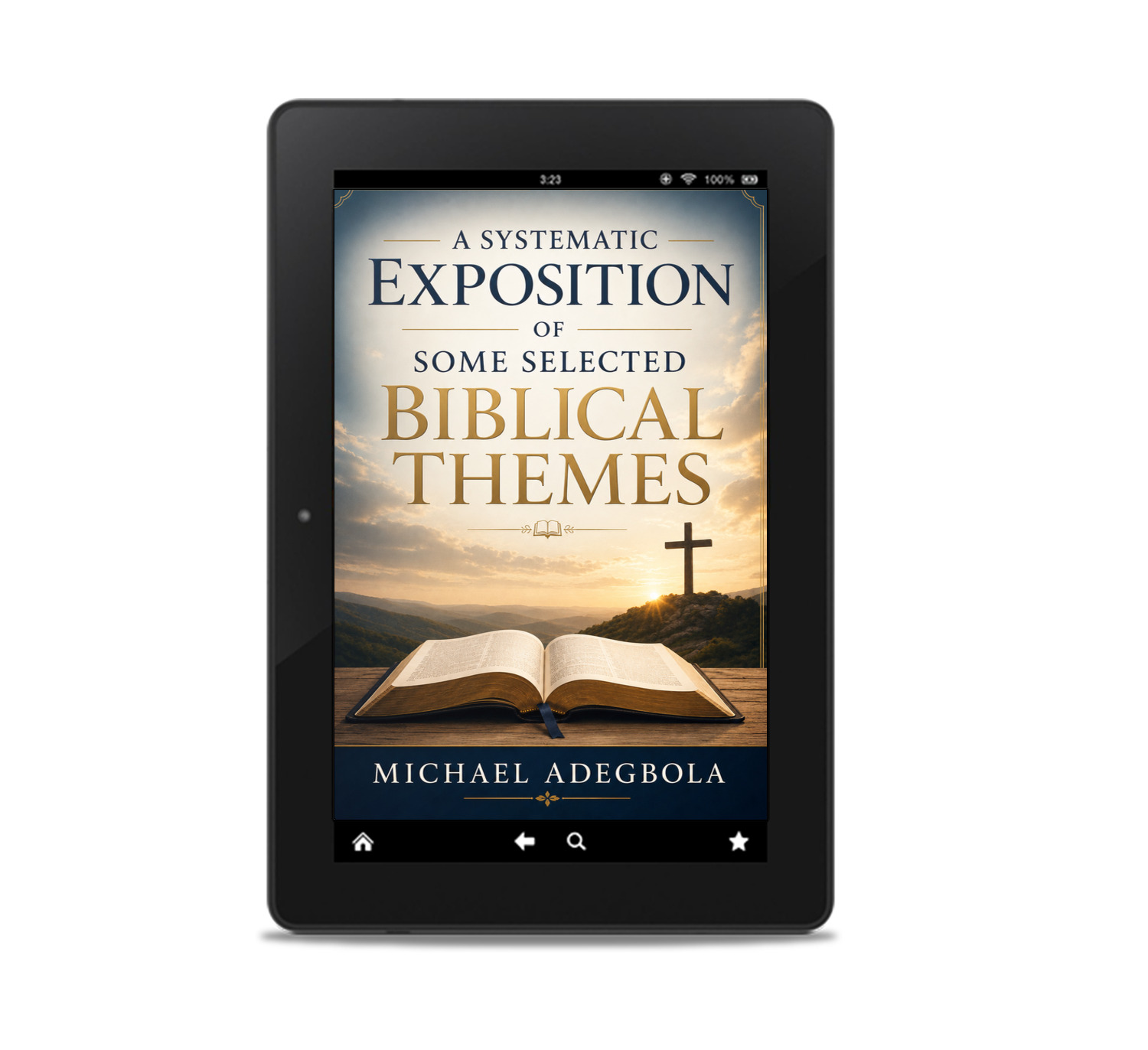
A Systematic Exposition of Some Selected Biblical Themes

The essays gathered in this volume represent a sustained effort to bring the resources of careful biblical exegesis to bear upon the great themes of apostolic theology. They do not constitute a systematic theology in the classical sense — no attempt is made here to treat the whole body of Christian doctrine in ordered sequence — but they are systematic in the more modest and perhaps more honest sense: they take up particular themes of revealed truth, pursue them with methodological seriousness through the texts of the New Testament and, where the canon demands it, the Old, and seek to set before the reader what the Holy Spirit has caused to be written for the instruction, correction, and edification of the church in every age.
The method that governs these studies is, in the first instance, grammatical-historical exegesis. The authors of the New Testament wrote in the Greek of the first century, and their meaning is inseparable from the language they employed. Throughout this volume, attention is given to the Greek text — to the force of particular words, to the significance of tense and mood and syntax, to the rhetorical and literary conventions within which the apostles worked. This is not pedantry. It is fidelity. Words carry freight, and the freight that the apostles loaded into their vocabulary — words such as dikaiosunē, hagiasmos, klēronomia, paraklēsis, koinōnia — cannot be adequately conveyed without some reckoning with the semantic world from which they came and the theological weight they bear in their inspired contexts. The reader will therefore encounter, at appropriate points, engagement with the Greek text in transliteration, together with attention to lexical range and contextual meaning.
Underlying this methodological commitment is a theological conviction that is foundational to everything that follows. The Holy Scriptures of the Old and New Testaments are received in these pages as the written Word of God — verbally inspired, entirely trustworthy, and possessed of an authority that is not derivative from the church that receives them, nor contingent upon the assent of the scholar who studies them, but intrinsic to their nature as the oracles of the living God. This conviction is not stated here as a concession to confessional convention, nor as a preliminary disclaimer designed to reassure a particular readership. It is the epistemological foundation upon which the entire enterprise rests. If the Scriptures are what they claim to be — and the argument of these pages proceeds on the assumption that they are — then the proper response to them is not critical detachment but believing attentiveness, not the adjudication of their claims before the bar of contemporary scholarship but the submission of the mind and heart to their authority as the norma normans of Christian thought and life.
This does not mean that the historical and literary dimensions of the biblical texts are treated with indifference. On the contrary, the grammatical-historical method is itself a form of respect for the humanity of the Scriptures — for the fact that God was pleased to speak through particular men, in particular languages, at particular moments in the history of redemption, addressing particular communities whose circumstances and questions shaped the form, though not the content, of the divine message. Attention to these dimensions is not an alternative to confessional reading but its necessary complement. To understand what Paul wrote to the Romans or the Corinthians or the Ephesians is to understand more fully what God has said to the church of every generation, for the word that was breathed out through the apostle's pen has not exhausted its meaning in the first-century communities that first received it. It speaks still, with undiminished authority, to all who will hear.
The three sections into which this volume is divided reflect the organic structure of apostolic theology as it unfolds across the pages of the New Testament. The first section addresses what may be called the soteriological foundations of Christian existence. Here the reader will find extended treatment of justification by faith — that article on which, in Luther's celebrated phrase, the church stands or falls — together with studies in sanctification, in the spiritual riches that belong to the believer in union with Christ, and in the inheritance that the New Testament sets before the people of God as the goal and consummation of their redemption. These themes are not treated in isolation from one another. They belong together in the apostolic proclamation, and the effort throughout is to honour their interconnection without collapsing their distinctions — to see justification and sanctification, for instance, as inseparable in the experience of the redeemed whilst remaining irreducibly distinct in their nature and ground.
The second section turns to the theology and practice of prayer, approached through the luminous particularity of the biblical narrative. It begins where Christian prayer must always begin — with Jesus Himself, whose own life of prayer constitutes both the pattern and the ground of all authentic communion with the Father. From the Lord's Prayer, which is at once instruction and gift, to the significant episodes in the prayer life of Jesus recorded in the Gospels, to the High Priestly Prayer of John 17 — that most interior and searching of all biblical prayers — the reader is drawn into the very heart of the relationship between the Son and the Father, and invited to consider what it means to be brought, through the Spirit of adoption, into the fellowship of that relationship. The section then extends outward to the apostolic prayers of Paul and the Epistle to the Hebrews, and reaches back into the devotional heritage of the Old Testament, where the communion of God's people with their covenant Lord takes forms that, read in the light of their fulfilment in Christ, disclose a depth and continuity that the canonical structure of Christian theology has always prized.
The third section addresses the church's public vocation — the proclamation of the gospel, the nature of apostolic and prophetic ministry, and the theology of Christian suffering. The characterisation of the gospel as the New Testament presents it is no trivial matter. In an age in which the word has been stretched to accommodate meanings that the apostles would not have recognised, it is urgent to return to the texts themselves and to hear again what the good news is — its content, its claim, its power, and the conditions under which it is faithfully handled. The treatment of apostolic and prophetic ministry is similarly concerned with the canonical witness rather than with subsequent ecclesiological convention, and the theology of suffering that closes the volume is perhaps the most pastorally urgent of all the themes addressed here, touching as it does the experience of every believer who has discovered that the way of Christ in the world is the way of the cross.
Throughout all three sections, the reader will observe a consistent set of interpretive commitments. The New Testament is read as the fulfilment and hermeneutical key of the Old, and the Old Testament as the indispensable matrix within which the New finds its deepest intelligibility. The letters and narratives of the apostolic age are read as addressed not merely to their original recipients but, through them, to the whole church of God, whose identity across time and culture is constituted by its common hearing of and submission to the one Word. The great tradition of biblical interpretation — patristic, Reformation, and Puritan — is drawn upon where it illuminates, not as an authority coordinate with Scripture, but as the accumulated wisdom of those who have read these texts before us, often with greater care and at greater cost than those of us who read them now. And the end in view throughout is not the production of academic commentary for its own sake, but the equipping of the people of God for understanding, believing, and living the truth as it is in Jesus Christ.
It remains only to say that these studies, though comprehensive in their ambition for the themes they address, are offered in the spirit of theologia genuflectens — of theology done on its knees. The writer who handles the Word of God without a sense of the holiness of the task, without the recognition that the texts he studies are not objects for analysis but the living address of the living God, has already misread them at the most fundamental level. Scholarship and devotion are not in tension here. They are, or ought to be, a single act of the renewed mind brought before the face of God. It is in that spirit that this volume is commended to the reader, with the prayer that the God who gave the Word will be pleased, through these imperfect engagements with it, to cause that Word to accomplish the purpose for which He sent it.