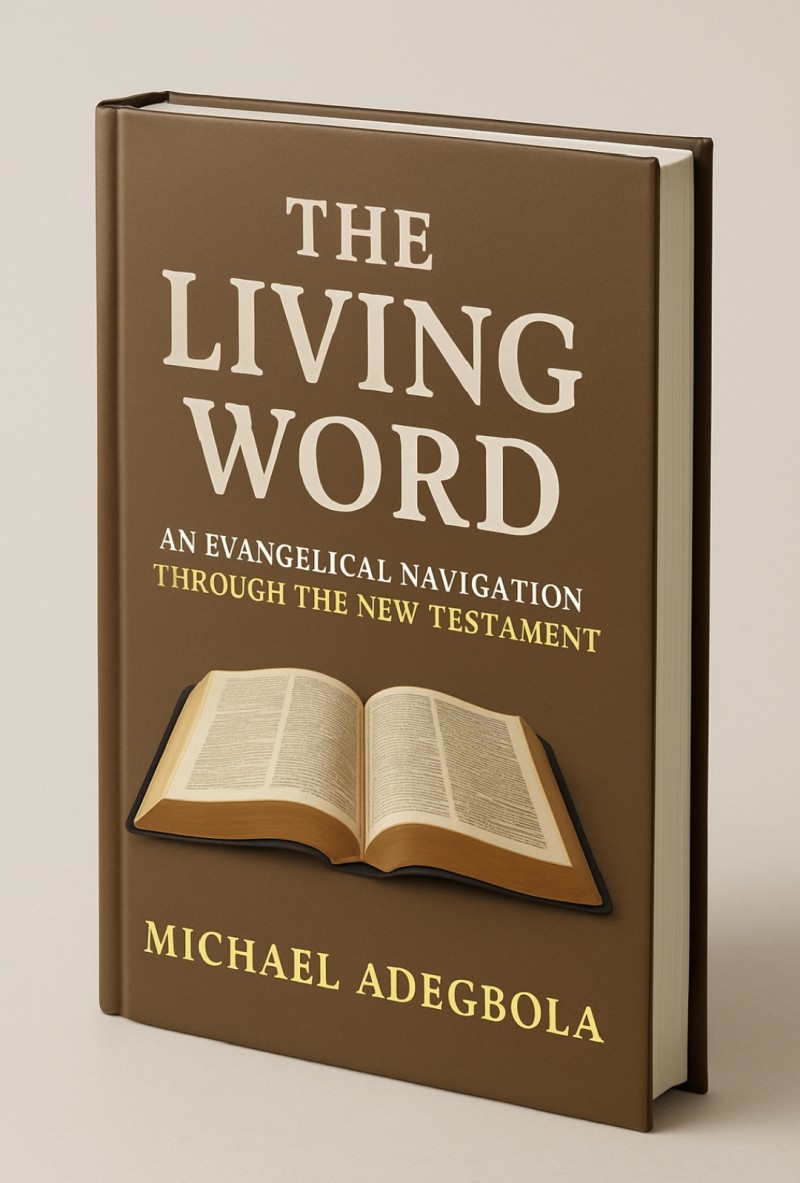
The Living Word: An Evangelical Navigation through the New Testament

INTRODUCING THE BOOK
522 pages
The Christian Church has always been, at its core, a people of the word. From the earliest apostolic sermons in Jerusalem to contemporary pulpits around the world, the proclamation of Scripture as the authoritative revelation of the living God has marked the heartbeat of Christian identity and mission. The New Testament, as the climactic fulfillment of the biblical drama, bears witness to the incarnate Christ, the risen Lord, and the birth and expansion of His Church. In The Living Word: An Evangelical Navigation through the New Testament, we undertake a comprehensive and methodologically careful journey through each book of the New Testament, interpreting it with the conviction that these texts, breathed out by God, remain authoritative, transformative, and urgently relevant for the Church today.
This work arises out of a deep commitment to the conservative evangelical tradition, which upholds the Bible as the inspired, inerrant, and infallible word of God. This is not merely a doctrinal preamble but a hermeneutical commitment—one that shapes the interpretive stance taken throughout this volume. While we engage the insights of diverse academic methodologies—historical, literary, social-scientific, and theological—our compass is ultimately the evangelical conviction that Scripture must be read as the living voice of God, trustworthy and sufficient, interpreted in the light of the gospel, and received in the context of the believing community.
Hermeneutical and Methodological Foundations
A foundational feature of this volume is its sustained reflection on hermeneutical method. The modern and postmodern theological landscape has seen a proliferation of interpretive approaches, some of which offer valuable tools for understanding the historical and literary dimensions of the text. Others, however, emerge from philosophical or ideological commitments that undermine the authority or unity of Scripture. While this volume is not unaware of the complexity of interpretive theory, it affirms that the proper interpretation of Scripture must be both spiritually responsive and historically responsible.
Thus, we advocate for a canonical, Christocentric, and ecclesially anchored hermeneutic. The canon, received by the Church under the providence of God, provides the theological context in which each book is to be read. The center of the canon is Christ, in whom all Scripture finds its fulfillment and coherence. And the Church, as the community of the Spirit, is both the recipient and interpreter of Scripture—not infallibly, but humbly and communally under the guidance of the Spirit and the rule of Scripture itself.
In practical terms, this volume engages each New Testament book through a framework that integrates responsible historical inquiry with evangelical theological interpretation. Issues such as authorship, provenance, date, and original audience are treated with seriousness and care, not as academic distractions but as essential components of sound interpretation. These matters are explored within the bounds of historical plausibility and fidelity to the biblical text.
At the same time, the focus extends beyond historical reconstruction. The purpose is not merely to determine what the texts once meant, but to discern their continuing relevance and meaning. Interpretation, as approached here, is not an end in itself but a means toward clarity, coherence, and conviction regarding the message of the New Testament as a whole. Each book is considered not only in its original context but also in terms of its ongoing significance for Christian thought, practice, and engagement in the present age.
Structure and Scope of the Volume
This volume is structured around a detailed, book-by-book exploration of the entire New Testament. Each chapter adheres to a consistent format, ensuring both thoroughness and accessibility:
1. Historical background and authorship: Investigating the cultural, political, and religious contexts of each book; presenting the evangelical consensus on authorship and provenance.
2. Date and original audience: Establishing the situational and chronological setting of each writing, including its purpose for the original readers.
3. Book Survey: Providing a concise yet theologically-rich overview of the book’s structure, themes, and message.
4. Purpose: Each book is examined for its central theological message and authorial intent, highlighting what the writer sought to communicate within their context. The aim is to show how each text contributes to the New Testament’s unified witness and ongoing theological significance.
5. Contribution to the Canon: Demonstrating how each book fits within the broader sweep of redemptive history and contributes to the unity of Scripture.
6. Contemporary Relevance: Reflecting on the ecclesial, pastoral, academic, personal, and prophetic significance of the book for today’s Church.
This framework is intended to serve multiple audiences: pastors preparing to preach, students engaging in rigorous theological study, church members pursuing deeper biblical knowledge, and leaders discerning how Scripture addresses contemporary cultural and ecclesial challenges.
Theological Conviction and Canonical Unity
The theological center of this work is the gospel of Jesus Christ—the crucified and risen Lord—through whom God has inaugurated His kingdom and redeemed a people for His name. All Scripture, and the New Testament in particular, bears unified witness to this gospel. The theological diversity of the New Testament—whether in the Synoptic Gospels, the Pauline corpus, the General Epistles, or the Johannine literature—is not a cause for fragmentation but a testimony to the manifold wisdom of God, who speaks in many voices yet with one divine breath.
This volume affirms the unity of Scripture not as a naive harmonization, but as a theological necessity rooted in the character of God. Each book is read within the horizon of the whole canon, and each author is treated as a faithful witness within the community of apostolic revelation. The result is a theology that is both diverse in expression and unified in truth.
The Prophetic Task of the Church Today
Beyond academic engagement and ecclesial instruction, this book seeks to serve the Church in its prophetic calling. In a time marked by moral confusion, doctrinal compromise, and cultural hostility to the truth of God, the Church must recover its prophetic voice—not one that merely reacts to the trends of the age, but one rooted in the eternal Word of God. Each New Testament book speaks not only to the first-century Church but also to ours, calling us to holiness, faithfulness, courage, and mission.
Our age requires more than theological literacy—it requires spiritual clarity and gospel resolve. The New Testament is not a neutral text to be studied from a distance; it is the living word of the living God, confronting, comforting, convicting, and commissioning His people. As such, this volume concludes each chapter with reflections designed to draw out the prophetic and pastoral implications of the text for contemporary ministry and discipleship.
Final Aim and Audience
The Living Word is written for a broad audience, yet with particular needs in view. For pastors, it serves as a resource for faithful, theologically-grounded exposition of Scripture. For scholars, it offers a model of rigorous evangelical engagement with critical scholarship. For students, it provides an accessible guide to the New Testament, integrating historical, literary, and theological insights. For church members, it invites a deeper encounter with God through His word and a life shaped by the gospel. And for the global Church, it stands as a contribution to the ongoing task of interpreting Scripture for every generation under the lordship of Christ.
In all things, we write not as neutral observers but as disciples of Christ, under the authority of His word, for the edification of His Church. It is our prayer that this volume will help readers to hear afresh the voice of God in the pages of the New Testament, and to respond with renewed faith, obedience, and hope.
For the word of God is living and active. And the Church must be, too.