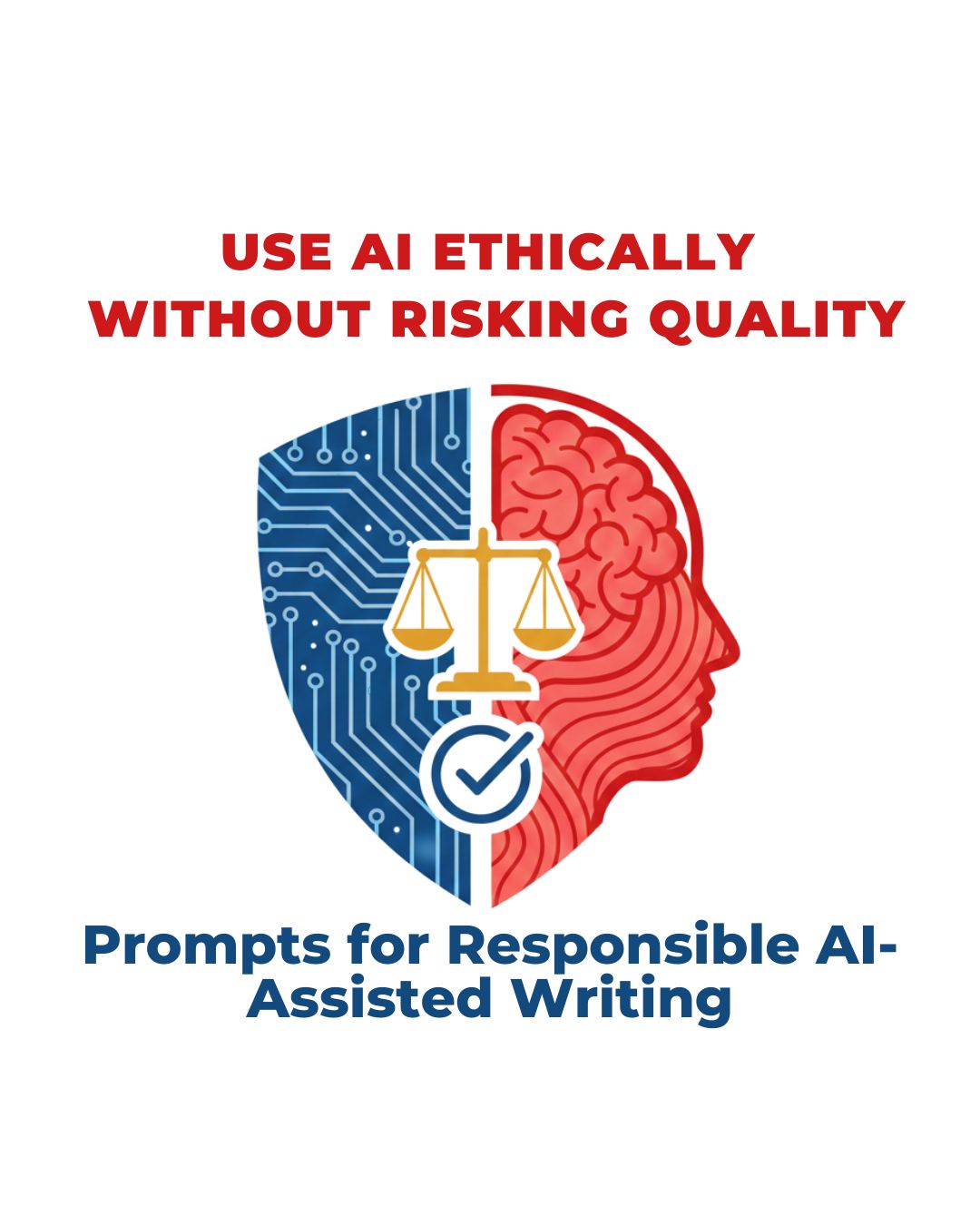
Prompts for Responsible AI-Assisted Writing
A lot of AI-generated content is technically correct and completely generic.
You know the content. In fact, you have read this type of content a thousand times before. It makes perfect sense in terms of structure and grammar. The tone is professional. And yet somehow, it says absolutely nothing. It reads like it was written by someone who has never had an original thought in their life.
You also might have tried writing something with the help of AI before. You probably went into ChatGPT, typed "Write me a LinkedIn post about productivity," and received a piece of content that was too generic and average. And you spent three hours rewriting it to make it high-quality. The AI did not save you time. It created more work.
This is the real issue with current AI writers. A lot of people tend to use them the wrong way.
You’ve already tried some approaches. Perhaps you bought an AI writing course, watched YouTube videos on prompting, and tried some "humanizers," which claim you can make your AI-generated content undetectable. Nothing works. Why?
Because courses on AI focus on giving you certain strategies for working with it. They help you understand better how to craft prompts. But they skip the most important part, which is knowing what you actually want to say first. While many people believe they can rely on AI to create ideas, in reality, it is your task. You should develop an individual voice in your text and a certain viewpoint. Generic prompting creates generic content. When you ask AI to "write me an article," it will give you a statistical representation of all articles written on that topic. This is quite logical, but it is just average content, and there will be nothing special about it. There will be no unique voice, perspective, or anything else. And even though some of these "humanizers" might work, they are ineffective against good detectors.
The actual solution is not in finding better prompt templates but in changing the entire workflow.
Instead of trying to come up with ideas using AI, try to polish and structure them.
Instead of relying on AI to do your thinking for you, rely on it to test the strength of your logic and help you articulate your point.
Such a process works because your request from AI does not concern creativity but clarity and structure. You are asking it to be an editor. And AI is excellent at editing. When you use AI as your editor, your content will become clear and well-structured, not generic and uninteresting.
This is my response to the problem: I created a tool specifically aimed at solving it. I titled it Prompts for Responsible AI-Assisted Writing. It is a guide containing 120 professionally written prompts based on one core principle, which is: you provide the ideas, and AI assists you with refining them. This is neither a tutorial nor a collection of generic templates but a full system for responsible usage of AI for people who actually want to use AI without sacrificing quality.
Here is what you will receive: 120 prompts under 20 different categories such as social media captions, persuasion and sales, educational content, criticism, comments and responses, debates, etc. It is everything a professional actually uses on an ongoing basis to write content professionally. There is no need to search for prompts around the Internet anymore. You have them all here, divided into categories you will be using.
Every single prompt requires your draft first. This is mandatory. There is no possibility of simply inserting your information into brackets and relying entirely on AI to do the rest. You fill in bracketed sections with your actual ideas, your thinking, and your perspective. This may seem like extra work, but it is absolutely necessary for the entire process to work. You produce content that is actually yours because you are making the thinking decisions, not the AI.
The prompts are designed for quality. Each one includes specific instructions on tone, audience, length, and desired outcome. You know exactly how the output should turn out. There is no room left for vague directions. No "make it better" or "improve it." All you do is ask and get what you want. You spend less time editing the output and save time by getting the task right the first time. I've also included a three-rule framework that runs through the entire guide. Never start with the prompt. Your job is not to publish AI output. Treat AI output as a first draft. These three rules will help you maintain control of your voice, quality, and ideas.
You will get guidelines for ethical use as well. Clear standards on when to use AI and when not to.
A list of useful tools and resources has been included too. A critical look into AI plagiarism checkers, detectors, fact-checkers, and other quality assurance tools.
And if you need a prompt for something specific to your industry or niche, I included instructions on how to prompt AI to generate customized prompts that follow the same ethical framework. The process is scalable according to your specific needs and requirements, rather than generic categories.
That being said, I know what you might be thinking. You've likely been told this all before. "Just improve your use of AI technology. Just provide better prompts. Just use this framework." And you are doubtful because no matter how many courses you've taken, no matter what tools you've bought, nothing has ever really helped you. Everyone promises results but provides only generic advice and tools that complicate your life even further.
The difference here is that this is not about marketing or hype. It is about addressing the actual problem with your content creation process. The issue does not lie with the AI; it lies with the way we engage with it. We ask it to think for us, but it should only help us refine our thoughts. When you switch that around (to first generating ideas and then having the AI refine them), everything else changes. Your content gets better. It gets faster. And it actually sounds like you.
$3 for a system that will completely change how you use AI. That is fair. Because as soon as it all clicks into place and you start using the AI tool to help you write better instead of generating things that are not even yours, you will wonder how you ever worked any other way. Your writing will be clearer. Your ideas will be sharper. And people will actually remember what you wrote instead of skimming past it like they do with everyone else's AI content.
Get the guide. Use it. Write something better tomorrow than you have written today. And if it's not what you expected, ask for your money back. That’s all there is to it. No risks. Just better writing.