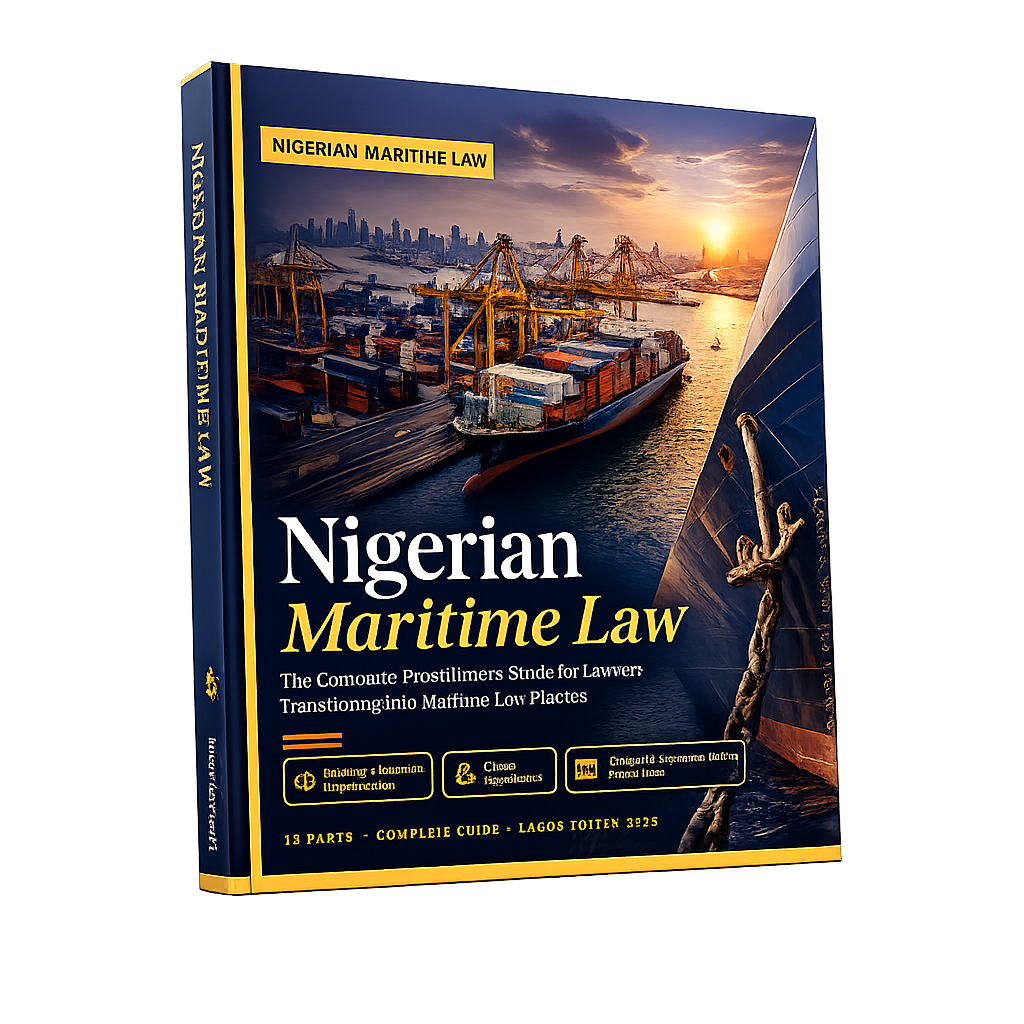
Nigerian Maritime Law: The Complete Practitioner's Guide for Lawyers Transitioning into Maritime Law Practice

The Nigerian Lawyer's Complete Guide to Maritime Law Practice
The only practical, Nigeria-specific guide for experienced lawyers ready to transition into one of the country's most lucrative and underserved legal markets.
Ship Arrest · Admiralty Jurisdiction · Cargo Claims · NIMASA Compliance · Maritime Arbitration · ₦0 to ₦10M Roadmap
~~₦15,000~~ ₦5,000 — Instant PDF download. Secure payment via Selar.
You know you should be in maritime law. But where do you even begin?
Nigeria handles over 80% of West Africa's cargo. FPSOs export 1.3 million barrels of oil every single day. Ship arrests happen weekly at Apapa. And yet — the pool of qualified maritime lawyers in Lagos remains desperately thin. The fees are extraordinary. The clients are serious. The work is waiting.
But most lawyers don't know how to break in.
No clear starting point. Maritime law feels like a closed world with no door. Where do you begin when there's no training contract, no mentor, and no roadmap?
Scattered, generic resources. Most maritime law textbooks are English, academic, and irrelevant to the Nigerian market. There is almost nothing written specifically for the Lagos practitioner.
No client acquisition strategy. Even lawyers who study maritime law don't know how to find the shipping companies, freight forwarders, and offshore operators who actually pay for legal services.
No income during transition. How do you transition without abandoning your existing practice? How long before maritime law starts paying? What exactly do you do in Month 1?
The solution: 12 parts. Everything you need. Nothing you don't.
This guide was written for the experienced Nigerian lawyer — someone with solid legal foundations who needs a practical, immediately actionable transition plan into maritime law. Every page is Nigeria-specific. Every case cited is Nigerian. Every fee structure reflects the Lagos market.
PART I — Understanding Maritime Law in Nigeria Scope, admiralty jurisdiction, the Blue Economy, and all 12 industry stakeholders you need to know — from ship owners and P&I Clubs to NIMASA, NPA, and offshore oil companies.
PART II — The Legal Framework 7 Nigerian statutes and 10 international conventions explained in plain, practice-ready language. The AJA, Merchant Shipping Act, Cabotage Act, NIMASA Act, MARPOL, UNCLOS, MLC 2006, and more.
PART III — Maritime Disputes Cargo claims, ship arrest, marine insurance, oil spill litigation, and charter party disputes — the legal principles, exact procedure, and typical clients for each dispute type.
PART IV — Building a Maritime Practice A phased roadmap from Day 1 to Month 12. What to read in Week 1. Which courses to enrol in by Month 3. What certifications to pursue by Month 6. What revenue to target by Month 12.
PART V — Client Acquisition Target client types, fee structures, retainerships, a 6-pillar networking strategy, and the exact LinkedIn approach that makes maritime clients come to you.
PART VI — Maritime Law Department Setup Full staff structure, salaries, Year 1 to Year 3 revenue projections (₦28M growing to ₦148M), and a complete service menu for your maritime practice.
PART VII — Maritime Law Documents Three ready-to-adapt templates: a cargo claim notice, a ship arrest affidavit in support, and a maritime legal services retainership agreement — with drafting notes on each.
PART VIII — Court Practice at the Federal High Court The 7-stage anatomy of a ship arrest, approximate filing fees, Mareva injunctions, sister ship arrest, and the practical tips that no textbook tells you.
PART IX — Maritime Arbitration LMAA, SCMA, and the Lagos Court of Arbitration explained — plus a 6-step roadmap to becoming a maritime arbitrator earning USD 300–600 per hour.
PART X — Career Development: 3-Year Roadmap Year-by-year milestones, the right professional associations to join (and in what order), and a LinkedIn strategy that builds a client pipeline within 6 months.
PART XI — The 8 Most Profitable Niches Oil and gas shipping, ship finance, maritime arbitration, marine insurance, port law, cabotage compliance, oil spill litigation, and customs advisory — ranked by income potential, entry barriers, and speed of market entry.
PART XII — 12-Month Implementation Action Plan Month-by-month milestones, KPIs, networking targets, a full ₦4.9M budget breakdown, and a ₦5M–₦10M Year 1 revenue target with a clear path to get there.
After reading this guide, you will know exactly what to do — and in what order.
✅ How to arrest a ship at Apapa Port, step by step, with every required document listed
✅ All 22 maritime claim categories under the Admiralty Jurisdiction Act you can sue upon
✅ How to write a cargo claim notice that preserves your client's rights and meets the 3-day rule
✅ Exactly which clients to target first, what to say to them, and what to charge
✅ How to build 5–8 monthly retainerships generating ₦3M+ in guaranteed base income
✅ The conferences, associations, and LinkedIn strategies that make maritime clients find you
✅ A realistic 3-year plan from ₦0 to ₦40M–₦80M in maritime revenue with annual milestones
✅ The full pathway to becoming a maritime arbitrator earning USD 300–600 per hour
What readers are saying
⭐⭐⭐⭐⭐ "I've been practising for 11 years and felt completely lost on where to start with maritime law. This guide gave me a day-by-day plan. I signed my first shipping company retainer within 6 weeks of reading it." — Adaeze O., Commercial Lawyer, Lagos
⭐⭐⭐⭐⭐ "The ship arrest template alone was worth ten times the price. I adapted it for my first in rem action and we had security from the P&I Club within 18 hours of the vessel arriving at Apapa." — Emeka I., Litigation Partner, Abuja
⭐⭐⭐⭐⭐ "I had no idea the cabotage waiver practice was this large. After reading Part VI, I approached three offshore logistics companies with a proposal. All three are now on retainer. The ROI on this guide is embarrassing." — Fatima K., Solo Practitioner, Lagos
⭐⭐⭐⭐⭐ "I've read Omotosho's textbook and several Lloyd's publications. This guide is different. It's the first resource that actually tells you what to do in Month 1 as a Nigerian lawyer. Indispensable." — Tobi N., Corporate Counsel, Port Harcourt
Everything included in your purchase
📄 The Complete Guide — 36 Pages, 12 Parts Fully formatted, professionally designed PDF. Readable on any device, printable at A4 size.
📋 3 Ready-to-Adapt Legal Document Templates Cargo claim notice · Ship arrest affidavit · Maritime retainership agreement
📊 3-Year Revenue Projection Model Broken down by service line, from ₦28M in Year 1 to ₦148M in Year 3.
📅 Month-by-Month 12-Month Action Plan KPIs, learning activities, networking targets, and budget allocations for every single month.
📚 Priority Reading List and Textbook Library Exactly which books to buy first, in what order, with colour-coded priority ratings.
🔄 Free Lifetime Updates Receive updated editions as Nigerian maritime law and NIMASA regulations evolve — at no extra cost.
Common questions
Is this guide relevant if I'm based in Abuja or Port Harcourt, not Lagos? Yes. While the guide references Lagos and Apapa Port as the primary maritime hub, the legal framework — the AJA, the Merchant Shipping Act, NIMASA regulations, and FHC admiralty procedure — applies nationwide. Port Harcourt is specifically relevant for offshore oil and gas shipping work, covered in depth in Parts I and XI.
I have no maritime background at all. Will I be able to follow this? Absolutely. The guide is written precisely for lawyers coming from other practice areas — corporate, litigation, commercial, property. Part I starts from first principles. If you understand contract law and can file in the Federal High Court, you have all the foundational knowledge needed.
How quickly can I realistically start earning from maritime work? Months 1–3 are investment phase — learning and outreach, with minimal revenue. Months 4–6 typically yield ₦500K–₦1M from advisory and compliance work. Months 7–12 scale to ₦2M–₦5M per quarter as retainerships and litigation instructions accumulate. Year 1 total target: ₦5M–₦10M.
Is the legal information up to date? Yes. The guide reflects current Nigerian maritime law including the Arbitration and Mediation Act 2023, the Petroleum Industry Act 2021, the Ministry of Marine and Blue Economy (established 2023), IMO 2020 sulphur regulations, and current FHC admiralty filing fees. Purchasers receive free updates as the law changes.
What format is the guide delivered in? A professionally designed, fully formatted PDF — 36 pages, 12 parts, with images, tables, document templates, and colour-coded sections. Instantly downloadable from Selar immediately after payment.
7-Day Full Refund Guarantee
If you read this guide and genuinely feel it hasn't given you a clear, actionable path into maritime law practice in Nigeria, email us within 7 days of purchase for a full and immediate refund. No questions. No hassle. We are that confident in what's inside.
The Nigerian maritime industry is open. Are you?
Every week that passes is a cargo claim unhandled, a ship arrest unfiled, and a retainer unclaimed — by someone else. Your years of legal experience are exactly what this market needs. The only thing missing is the roadmap. Here it is.
ONE-TIME PAYMENT: ₦5,000
🔒 Secure payment via Selar · ⬇️ Instant PDF delivery · 🔄 Free lifetime updates · 🛡️ 7-day money-back guarantee