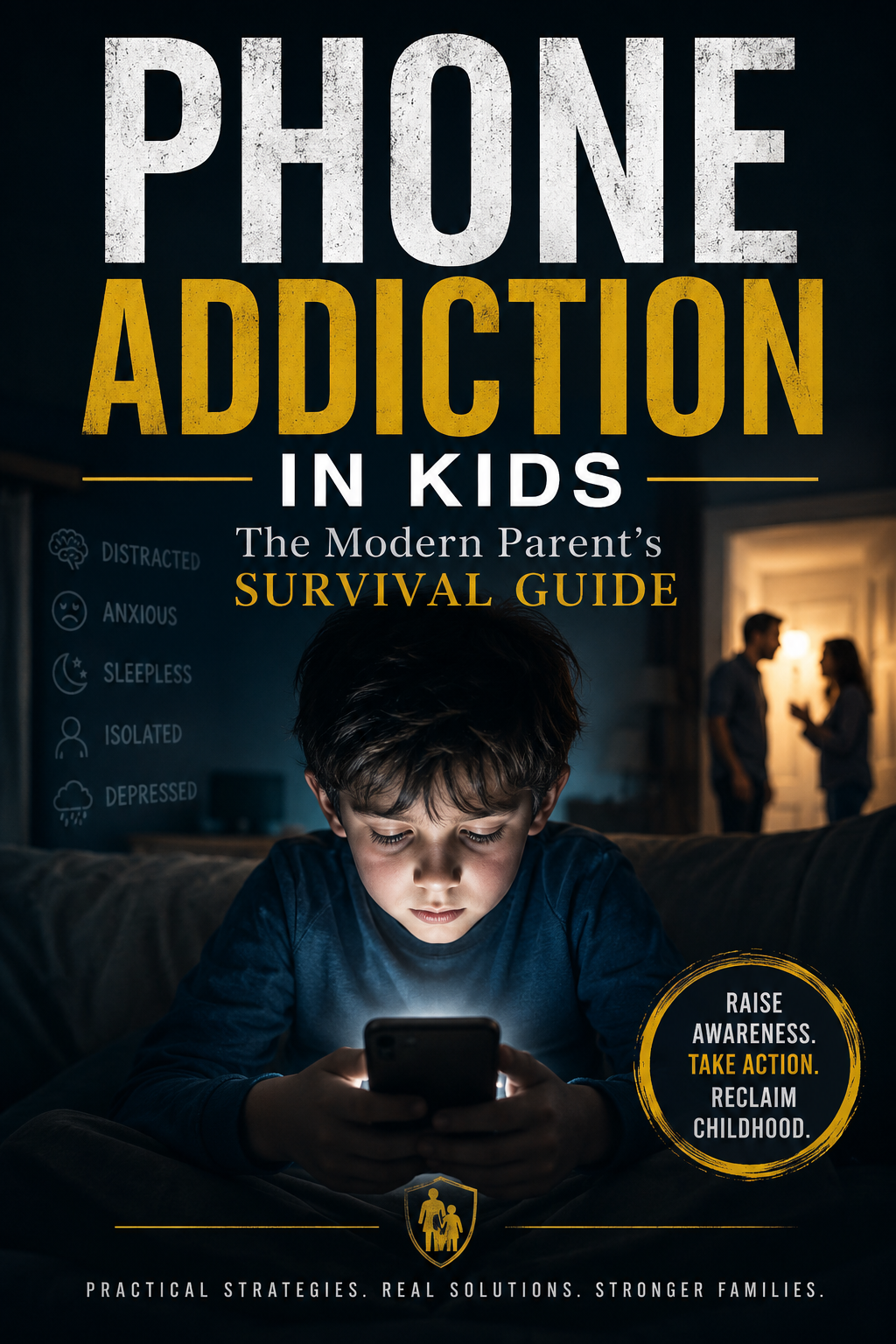
PHONE ADDICTION IN KIDS {The Modern Parent's Survival Guide}
Why This Book Is Not About Banning Screens
I’ve been a parent for longer than the iPhone has existed. I’ve also been a professional writer watching families tear themselves apart over a glowing rectangle.
Here is what I know for sure: A total ban does not work. You can lock the iPad in a safe, and your child will find a friend’s device, a school Chromebook, or a smart TV. The goal is not to raise a child who never touches a screen. The goal is to raise a child who can put down a screen without a war.
This book is for the parent who has already thrown a phone across the room. For the mother who cried in the car after a 45‑minute argument about TikTok. For the father who feels like a parole officer in his own home.
You are not alone. And you are not failing. You are fighting an algorithm that spends billions to keep your child’s eyes open. Let’s change the battlefield.
JUST A LITTLE SNEAK...........
Part One: Understanding the
Beast
Chapter 1:
The Dopamine Factory – What You’re Actually Fighting
Every time your child gets a like, a new snap, or a victory royale, their brain releases dopamine—the same neurotransmitter involved in cocaine addiction. This is not a metaphor. MRI studies show that the nucleus accumbens (the reward center) lights up brighter for a notification than for a real‑life hug.
The phone is not a toy. It is a dopamine delivery device. And your child’s prefrontal cortex—the part of the brain that says “stop, it’s bedtime”—won’t be fully developed until age 25.
So when you ask, “Why can’t he just put it down?” the answer is: Because his brain is
literally not equipped to. You wouldn’t blame a toddler for wetting the bed. Stop blaming a tween for being unable to self‑regulate a slot machine.
The veteran solution: Stop expecting self‑control. Build external controls. The next three chapters show you how.
Table of Contents:
Introduction
Part One: Understanding the Beast
Chapter 1: The Dopamine Factory – What You’re Actually Fighting
Chapter 2: The Myth of the “Lazy Kid” – Executive Function vs. Addiction
Chapter 3: Why Yelling, Shaming, and Taking the Phone Don’t Work (The
Escalation Trap)
Part Two: The Architecture of Peace
Chapter 4: The Container Method – Replacing Timers with Logical Boundaries
Chapter 5: The Transition Object – How to End the Screaming at Turn‑Off
Chapter 6: The Tech Closet – Your Family’s Nuclear Option That Actually Saves Sanity
Chapter 7: The Boredom Contract – Retraining the Brain to Tolerate Stillness
Part Three: Age by Age – What Works When
Chapter 8: Toddlers & Preschool (Ages 2–5)
Screens Are Not Babysitters
Chapter 9: The Elementary Years (Ages 6–10) – First Phone, First Rules
Chapter 10: Tweens (Ages 11–13) – Social Media, Group Chats, and the Comparison Trap
Chapter 12: The 10‑Second Rule – Interrupting the Dopamine Trance
Chapter 13: The Family Charging Station Ritual (That Includes You)
Chapter 14: How to Say “No” Without a Lecture – The Gray Rock Method for Parents
Chapter 15: The Mirror Check – Why Your Own Phone Is the Real Problem
Part Five: When Things Go Off the Rails
Chapter 16: The Meltdown Playbook – What to Do When They Scream, Throw, or Hide
Chapter 17: Secret Screens – Managing the Smartwatch, the Old iPad, and the School Laptop
Chapter 18: Rebuilding Trust After a Digital Betrayal (Secret Accounts, Late‑Night Scrolling)
Conclusion: Your Child Is Not Broken – Neither Are You
Appendix
- A. Sample Family Technology Agreement (Printable)
- B. 25 Analog Activities for the Boredom Contract
- C. Recommended Screen Time Limits by Age (American Academy of Pediatrics + Veteran Adjustments)
- D. A Note to the Exhausted Parent – When You’ve Already Screamed Today
Your Child Is Not Broken – Neither Are You
I have written thousands of pages over thirty years. This is the most important one.
The phone is not going away. The algorithm is not getting kinder. But you are not powerless. You are the architect of your home. You can build walls of ritual, floors of calm, and windows of connection that no screen can
replace.
You will still have bad days. You will still yell sometimes. Forgive yourself. Then go put the phone in the closet, make some popcorn, and sit next to your kid. They don’t need a perfect parent. They need a present one.