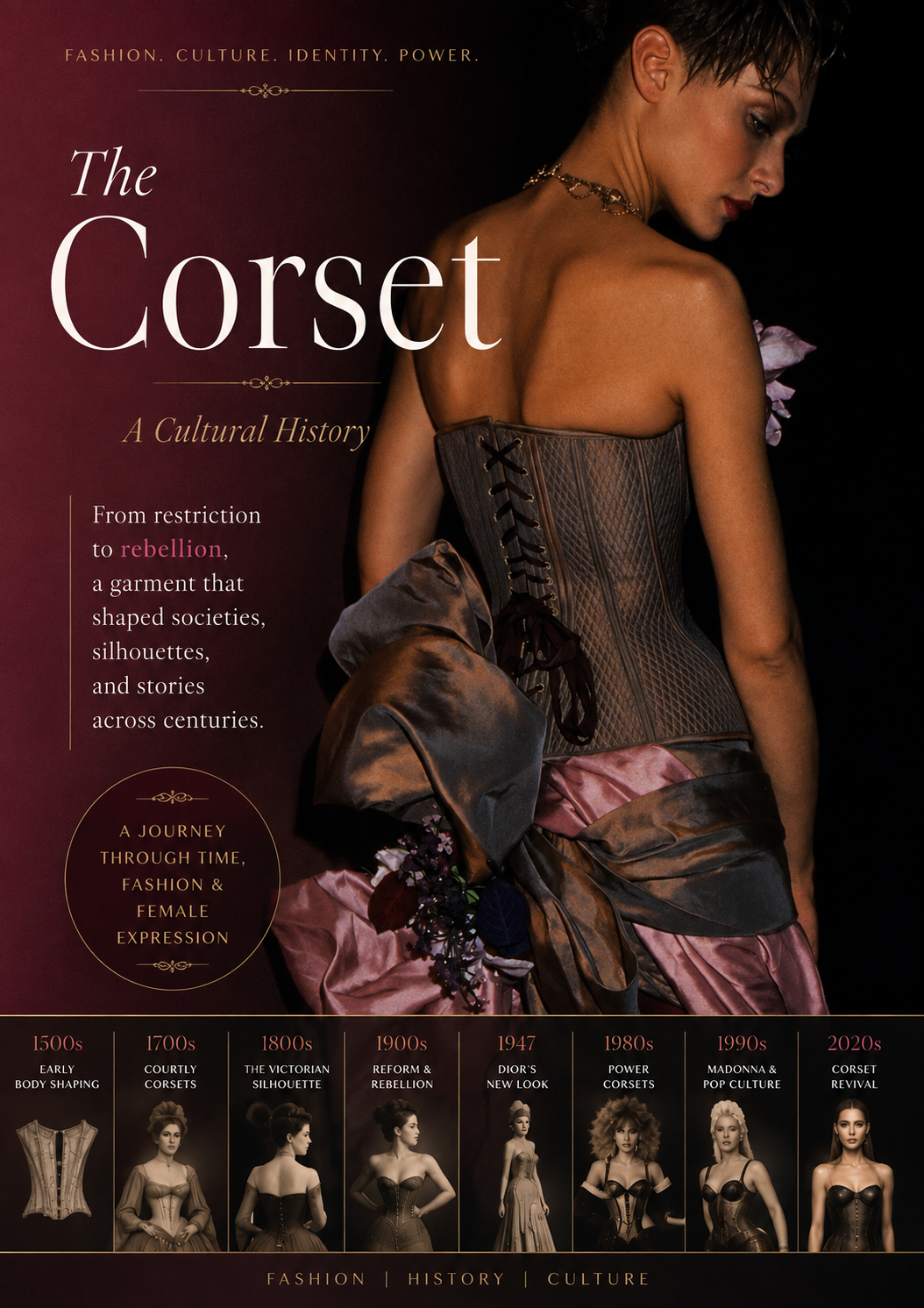
The Corset: A Cultural History
The Corset: A Cultural History by Valerie Steele (Yale University Press, 2001) is a landmark scholarly study that reexamines one of fashion history’s most debated garments. Steele, a leading fashion historian and director of The Museum at FIT, challenges long-standing myths and binary narratives surrounding the corset, offering a nuanced cultural history spanning from the Renaissance to the late 20th/early 21st century.
Core Argument
Steele rejects the dominant frameworks that cast the corset primarily as either an instrument of patriarchal oppression versus female liberation, or as a conflict between fashion and health/comfort. Instead, she demonstrates that women’s experiences of corsetry were highly varied and complex. Drawing on extensive textual, visual, and material evidence, she argues that corsets were not inherently “dangerously unhealthy” nor designed mainly to oppress women. Women continued wearing them for centuries—often against the advice of male medical and moral authorities—because they carried positive associations with social status, self-discipline, youth, beauty, and erotic allure.
Key Themes and Content
- Historical persistence and decline: The book asks why women wore steel- and whalebone-reinforced corsets for roughly four hundred years (from the Renaissance into the 20th century) and why the practice eventually ended. Steele traces the garment’s evolving forms, meanings, and social roles across periods.
- Demolishing myths: She systematically refutes exaggerated claims about the corset’s health dangers (e.g., widespread organ displacement or death from tight-lacing) and its role as pure oppression, while acknowledging genuine discomfort and class/gender dimensions.
- Positive cultural meanings: Corsetry signaled refinement, control, and desirability. Tight-lacing was more limited and often more theatrical or specialized than popular accounts suggest.
- 20th-century transformation: As the external boned corset declined, its shaping function was “internalized” through diet, exercise, and later plastic surgery. The book ends with analyses of the corset’s modern reinvention: as a symbol of rebellion and female sexual empowerment, its revival in high fashion, and its shift from underwear to outerwear (e.g., in the work of designers who treated it as visible, erotic, or subversive fashion).
The book is lavishly illustrated with historical images, fashion plates, advertisements, medical illustrations, and contemporary examples that support Steele’s arguments.
Significance
Steele’s work stands as a corrective to earlier moralistic or overly simplified histories of the corset. It emphasizes agency, cultural meaning, and historical contingency over pure victimhood narratives. It remains a standard reference for fashion historians, costume designers, and anyone interested in the body, gender, and material culture.
In short, the book reframes the corset not as a straightforward tool of suffering or control, but as a complex cultural object whose meanings shifted with society—and whose influence persists even after the garment itself largely disappeared from everyday wear.