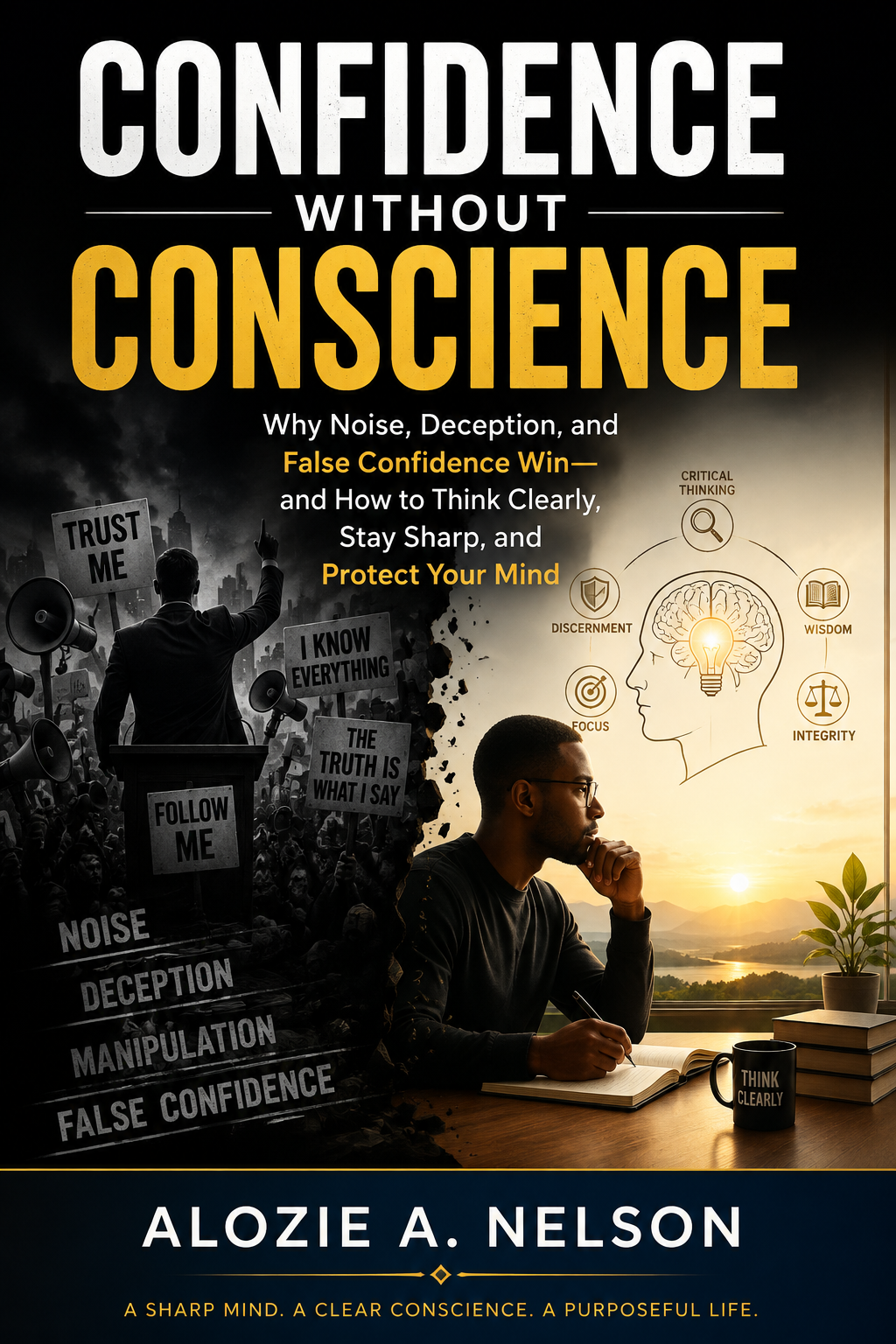
CONFIDENCE WITHOUT CONSCIENCE: Why Noise, Deception, and False Confidence Win— and How to Think Clearly, Stay Sharp, and Protect Your Mind. By ALOZIE A. NELSON

CONFIDENCE WITHOUT CONSCIENCE
Why Noise, Deception, and False Confidence Win—and How to Think Clearly, Stay Sharp, and Protect Your Mind
What if confidence is not always a sign of competence?
What if the person who speaks with the greatest certainty is not necessarily the person who knows the most?
We live in an age where loud voices compete for attention, confident opinions spread faster than careful reasoning, and repetition can make weak ideas appear credible. In such an environment, deception does not always look deceptive—and ignorance can sometimes sound remarkably intelligent.
Confidence Without Conscience examines the uncomfortable relationship between confidence, truth, influence, manipulation, and human judgment.
The book explores why people are often persuaded by certainty rather than evidence, why noise can overpower wisdom, how deception gains credibility, and why some individuals become influential without possessing the depth or integrity their confidence suggests.
But this is not merely a book about other people.
It is also a mirror. It challenges the reader to examine their own assumptions, emotional reactions, sources of information, and susceptibility to confident voices.
It asks an important question: How do you remain confident without becoming arrogant, informed without becoming manipulated, and skeptical without losing your ability to trust?
Through philosophical reflection, psychological insight, practical observations, and thought-provoking scenarios, Alozie A. Nelson explores the difference between confidence and competence, influence and truth, appearance and substance, persuasion and manipulation.
Ultimately, Confidence Without Conscience is an invitation to think more carefully in a world that increasingly rewards those who speak loudly rather than those who think deeply.
Not everything that sounds intelligent is wisdom.
Not everything that looks confident is competence.
And not everything that wins attention deserves your trust.