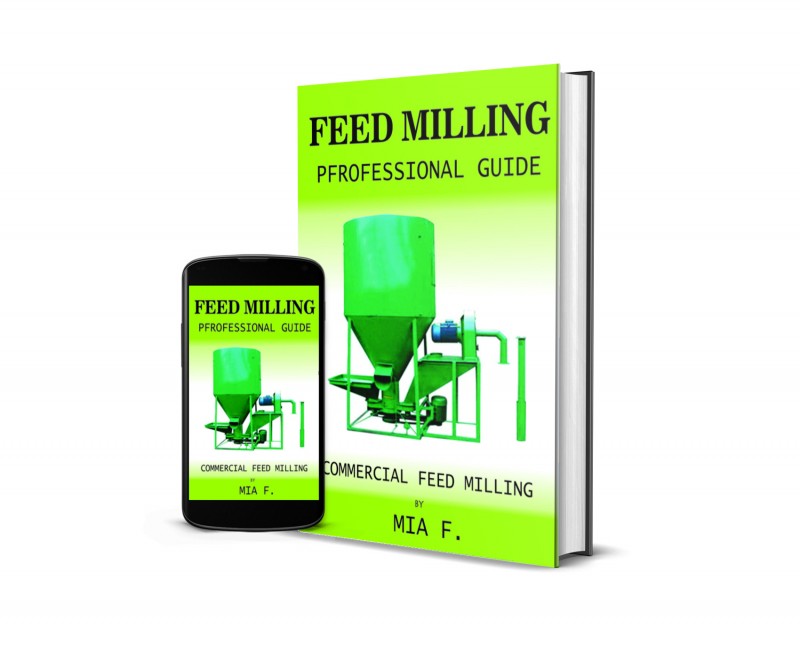
FEED MILLING PROFESSIONAL GUIDE
Setting up a feed mill can be a daunting task, but with the right guidance and careful planning, it can be a breeze. This professional guide will walk you through the fundamentals of what you’ll need to get started and how to get it.
Feed Mill Business is very lucrative in Nigeria because the demand is high due to the wide consumption of animal products all over the globe.
With the increase in the price of commercial feed, entrepreneurs should take this opportunity and invest in the Feed Mill business by purchasing a copy of FEED MILLING (Professional Guide) to learn the nitty-gritty of the business.
The process of grinding and processing feed ingredients into a form suitable for animal consumption is known as feed milling. Raw material handling, grinding, mixing, pelleting, and cooling are the five major stages of the feed milling process. Feed milling is an important step in the production of animal feed because it results in a uniform mixture that is easy for animals to digest.
There are a few things you should know if you want to start a feed mill. A feed mill is a factory that manufactures animal feed, most commonly from corn, wheat, and soybeans. It’s critical to have a solid understanding of the process and the tools needed to get started.
The following are the contents of the eBook for establishing a commercial feed mill:
CONTENTS OF THE BOOK
CHAPTER ONE
HANDLING OF RAW MATERIAL
Classification of Raw Materials
Methods of Sourcing for Raw Materials
Direct Source
In-Direct Source
Limitations and Constraints of Local Equipment
FEED MILLING MACHINERY AND EQUIPMENT
Nigeria’s Milling Industry
Industry Characteristics
Critical Success Factors
Challenges & Risk Factors
CHAPTER TWO
TYPES OF MACHINES
Hammer Milling
Feed Mixers
CHAPTER THREE
FEED MILLING PROCESS
Feed Manufacturing Process
Different processing methods:
Grain Milling for Feed
CHAPTER FOUR
HANDLING, LABELING, STORAGE, AND DELIVERY OF FINISHED PRODUCTS
HANDLING
LABELING
STORAGE
TRANSPORT OF FINISHED GOODS AND COMPONENTS
CHAPTER FIVE
LEGISLATION AND QUALITY CONTROL FOR COMMERCIAL FEED FORMULATIONS
LAWS GOVERNING ESTABLISHMENT OF FEED MILL
LEGISLATION ON ANIMAL FEED
LABELLING AND COMPOSITION
QUALITY CONTROL IN FEED FORMULATION
DETERMINING THE QUALITY OF INCOMING INGREDIENTS AND OUTGOING FEEDS
BULK INGREDIENTS AND MIXED FEED
BAGGED INGREDIENTS AND MIXED FEEDS
HAYS
SYRUPS AND FATS
USE OF CURRENT GOOD MANUFACTURING PRACTICES IN MAINTAINING QUALITY CONTROL
QUALITY CONTROL CHECKLIST FOR FEED
CHECKLIST FOR SOURCES OF HIGH OR LOW ANALYTICAL VALUES
CHECKLIST FOR OVERALL SYSTEM EFFICIENCY
CHECKLIST FOR PERFORMANCE EVALUATION
ADVANTAGES OF QUALITY CONTROL IN FEED FORMULATION
CHAPTER SIX
STANDARD ORGANIZATION AND FEED STANDARD
STANDARDS ORGANISATION OF NIGERIA (SON)
FEEDING STANDARDS
If this sounds interesting to you, purchase a copy and download it immediately to start utilizing what you have learned
Item Details: PDF | 51 pages