
How to Collect School Fees on Time
YOUR SCHOOL HAS EARNED THE FEES. IT JUST HASN'T COLLECTED THEM.
Build a firm, fair and predictable fee-collection system that helps your school receives more payments earlier, protect cash flow and pay staff on time.
For Nigerian private-school owners, proprietors, administrators and Bursars who are tired of vague promises, inconsistent follow-up and unpaid balances rolling into another term or session.
Get the complete digital guide and print-ready implementation toolkit for ₦10,000.
Instant download access through Selar. Read the guide on your phone or computer and print the toolkit pages your school needs.
If your school has pupils in the classroom but still struggles to pay salaries, suppliers and bills on time, low enrolment probably is not the problem.
The real problem is that too much of the money your school has already earned is still sitting in parents' pockets.
The children have resumed. Teachers are teaching. The generator is running. The bus is moving. Salaries are approaching.
And a good number of parents are still saying:
"Please give me until Friday."
"My salary hasn't entered."
"I'll transfer tomorrow."
"Let the child resume first, I'll pay later."
Friday comes. Nothing happens. Tomorrow becomes next week. Another reminder goes out. Another promise is made. And your school keeps carrying the cost while the parent keeps getting the service.
It doesn't have to stay this way.
IMAGINE A NEW TERM WHERE YOU'RE NOT BEGGING
Parents get their invoices before they've spent the money elsewhere. Every family knows exactly what to pay, when, and what options they have. Parents with irregular income are already contributing before resumption. Payment promises are written down, not left as phone calls. Reminders go out on schedule, without you personally chasing anyone.
Your bursar knows who has paid, who's on an approved plan, who has broken a promise, and what to do next.
Genuine hardship is handled with compassion. Deliberate default is handled with firmness. Influential parents can't quietly bypass the process. Teachers aren't turned into debt collectors. No child is embarrassed for an adult's unpaid bill.
That's the shift How to Collect School Fees on Time was built to give you.
YOUR SCHOOL DOESN'T NEED MORE PLEADING. IT NEEDS A SYSTEM.
Most Nigerian private schools don't have a real collection system. They have a fee list, an account number, an occasional WhatsApp message, and a phone call when money is urgently needed. That isn't a system.
A working system has clear answers to questions like:
- When should next term's invoice go out?
- How much should you aim to collect before resumption?
- Which parents deserve an instalment plan, and which don't?
- How are payment promises documented and tracked?
- What happens the moment a promise is broken?
- How do you tell genuine hardship from repeated excuses?
- Who has the authority to approve an extension or waiver?
- How do you recover old debt without damaging the relationship?
- How do you enforce fees without humiliating a child?
- How do you stop influential parents from quietly weakening the policy?
- How does management see, at a glance, whether collections are improving?
Without clear answers, every unpaid account becomes a fresh negotiation. Deadlines turn into suggestions. Exceptions become the norm. Parents learn the first reminder isn't serious, so they wait for the third or fourth.
The result: delayed salaries, impatient suppliers, postponed repairs, unnecessary borrowing, and the same struggle repeating every resumption. On paper, the school looks fine. In the account, the money isn't there when it's needed.
Fees billed are not the same as cash collected.
Say your school has 300 pupils paying an average of ₦150,000 a term. That's ₦45 million in expected fees. But if only ₦20 million has actually entered the account, your school doesn't have ₦45 million. It has ₦20 million in cash and ₦25 million in outstanding promises. Teachers, landlords and suppliers can't be paid with expected income. They need money that has actually landed.
This guide closes that gap.
INTRODUCING: HOW TO COLLECT SCHOOL FEES ON TIME
A practical fee-collection system built for Nigerian private schools.
This isn't a set of motivational ideas. It's an implementation system built for the reality that some parents earn a salary, others are traders, contractors, artisans or business owners with income that comes irregularly. Some parents genuinely need support. Others can pay, but keep postponing because the school has made late payment too comfortable.
Instead of treating every parent the same way, this system helps your school respond to the real situation in front of it. The goal is not to fight parents. It is to make prompt payment easier and more predictable, and to remove the quiet advantage that late payment currently enjoys.
WHAT CHANGES IN YOUR SCHOOL
1. More payments move to before resumption.
You'll learn how to start next term's collection process while the current term is still running, so parents can budget for it, set money aside, or start an approved payment plan before it becomes urgent.
2. Verbal promises become written commitments.
"I'll pay next week" isn't an arrangement. You'll learn how to turn every promise into a written record with the amount, the date, the consequence of missing it, and the next follow-up action. Documented promises are taken more seriously than spoken ones.
3. Parents with irregular income can actually keep up.
A lump sum at resumption doesn't fit how a trader or contractor earns. You'll learn how to set up structured advance contributions, weekly, fortnightly or monthly, so parents can prepare weeks ahead instead of asking for another extension after school resumes.
4. Hardship and habitual default stop being treated the same.
A parent facing a real emergency shouldn't be handled like a parent who has broken three promises and ignored every reminder. You'll learn how to classify accounts and respond accordingly, staying compassionate without letting "please understand" become an indefinite free pass.
5. Your deadlines start meaning something again.
When a school announces consequences it never enforces, parents stop believing the deadline. You'll get a gradual escalation process: reminder, personal follow-up, written commitment, broken-promise action, approved consequence, and formal recovery where needed. Every account has a next step, an owner, and a deadline.
6. Fewer disputes, less confusion.
Some late payments are the school's own fault: wrong invoices, uncredited transfers, missing sibling discounts, unclear charges, conflicting instructions from staff. You'll learn how to remove these friction points so a parent who wants to pay actually can, without a fight.
7. Teachers stop absorbing the school's cash-flow problem.
When fees come in earlier, you plan with real cash instead of expected income, reserve money for payroll, avoid unnecessary borrowing, and give your staff a more stable environment to work in.
8. Children stay protected while the school collects what it's owed.
No child should be embarrassed because a parent hasn't paid. You'll learn how to direct every collection action at the responsible adult, so your school can be firmer without becoming hostile or damaging its reputation.
THE FIRM, FAIR, PREDICTABLE METHOD
Firm. Deadlines are clear. Arrangements are documented. Broken promises lead to a defined next step, not another round of waiting.
Fair. Invoices are accurate. Genuine disputes are investigated. Hardship goes through a controlled process, and consequences are applied by approved criteria, not by who shouted loudest.
Predictable. Parents know what happens before a fee is due, when it's overdue, and when an arrangement is broken. Staff know their role. Management always knows what should happen next.
WHAT YOU GET
1. The Complete Guide
A full implementation walkthrough, from diagnosing why your current system is failing to building a payment culture that improves term after term. Inside, you'll learn how to:
- Calculate the real cost of late payment to your school
- Audit your current collection process
- Identify the different types of late-paying parents
- Build a fee policy parents actually understand
- Set expectations from the point of admission
- Structure fees, incentives and instalments without hurting cash flow
- Start collecting before resumption
- Introduce advance fee contributions
- Design payment plans parents are more likely to complete
- Make payments easy to identify and reconcile
- Run a scheduled reminder system
- Communicate value before you send the invoice
- Escalate overdue accounts professionally
- Separate hardship from habitual excuses
- Protect pupils during enforcement
- Recover old debt intelligently
- Roll the whole system out in 30 days
- Track results on a weekly collection dashboard
2. The Implementation Toolkit
You won't be starting from a blank page. This is a full set of customisable, print-ready and fillable resources.
Policy and agreement templates: fee payment policy, admission financial undertaking, parent billing form, policy acknowledgement, payment plan agreement, advance contribution agreement, contribution schedule, hardship application, temporary concession agreement, promise-to-pay form, exception approval register.
Parent communication templates: pre-resumption invoice, early-payment offer, due-date reminder, first overdue notice, phone follow-up script, promise-to-pay confirmation, broken-promise notice, formal final demand, fee adjustment letter, limited-time settlement offer, account clearance letter, value updates, termly value report, advance suspension notice.
Financial and collection tools: cash-flow pressure calculator, fee sustainability worksheet, early-payment discount calculator, instalment cost calculator, 25-point collection audit, weekly dashboard, aged-debt report, promise-to-pay tracker, discount and waiver register, dispute register, parent segmentation worksheet, eight-week pre-resumption calendar, escalation tools, debt recovery decision matrix, 30-day workbook, launch risk register.
Staff procedures: bursar's collection procedure, reconciliation procedure, child-safe enforcement protocol, parent data confidentiality procedure, staff escalation matrix, reception and security response script.
YOU CAN START IN 30 DAYS
The guide includes a practical rollout plan. In 30 days, you can measure where your collections stand today, fix billing and reconciliation gaps, approve a written policy, set collection targets, train your bursary staff, launch the new system to parents, and start tracking results weekly.
You don't need school-management software to begin. A smaller school can run the core system on bank transfers, WhatsApp Business, SMS and a well-managed spreadsheet. A larger school can apply the same principles through its parent portal or payment gateway. The technology changes. The principles don't.
PICTURE YOUR NEXT RESUMPTION
Invoices are already with parents before you're desperate for salary money. Payments carry the correct reference, so you're not scrolling through screenshots. Every serious commitment has an amount and a date attached to it. Your bursar works through an approved calendar instead of you calling every debtor yourself. Teachers focus on teaching. Financial conversations stay private and professional.
And every week, you can see: total billed, total collected, cash available, outstanding balances, instalments due, broken promises, open disputes, accounts needing escalation, old debt recovered, and progress against target.
You may still have a few outstanding accounts. But none of them will be invisible, forgotten, or running on empty promises. Each one has an owner, a category and a deadline.
WHO THIS IS FOR
Private school owners, proprietors, administrators, bursars, account officers, directors, faith-based school leaders, and anyone responsible for fee collection and cash flow.
It's especially worth it if:
- Parents regularly resume without paying
- Unpaid balances keep rolling into the next term
- Teacher salaries are affected by delayed collections
- Most arrangements are verbal
- You personally chase the difficult accounts
- Some parents quietly get exceptions others don't
- Reminders go out without a clear escalation process
- You struggle to separate hardship from excuses
- Parents keep disputing unclear balances
- You want to be firmer without embarrassing pupils
THIS ISN'T FOR YOU IF YOU'RE LOOKING FOR
- A magic message that makes every parent pay instantly
- A way to threaten or humiliate debtors
- A way to punish children for a parent's debt
- A guaranteed 100% collection rate
- Something you'll buy and never implement
- An excuse to keep ignoring poor invoicing or admin
This gives you the structure, procedures and tools. Your results depend on your school and how consistently you apply it.
ABOUT THE AUTHOR
Gabriel Ogunleye is an educator, author and business owner who has taught in more than seven schools across Lagos, Ogun and Oyo States. Across schools of every size and fee level, he kept seeing the same pattern: schools had earned the fees, but the money wasn't landing early enough to cover salaries, suppliers and basic obligations.
Teachers waited on pay. Owners struggled with suppliers. Administrators lost hours chasing parents. Arrangements were informal, deadlines were inconsistent, and influential parents sometimes found a way around the system.
That experience shaped this framework. Gabriel holds a B.Tech from the Federal University of Technology, Akure, an M.Sc from the University of Ibadan, and a Postgraduate Diploma in Strategic Christian Leadership from the Redeemers International Leadership Academy. He developed this guide by combining those observations with structured cash-flow, communication, documentation and implementation principles suited to Nigerian private schools.
His goal is simple: help schools collect the money they've already earned, early enough to pay teachers, maintain facilities, and deliver the education they promised.
ANOTHER TESTIMONIAL
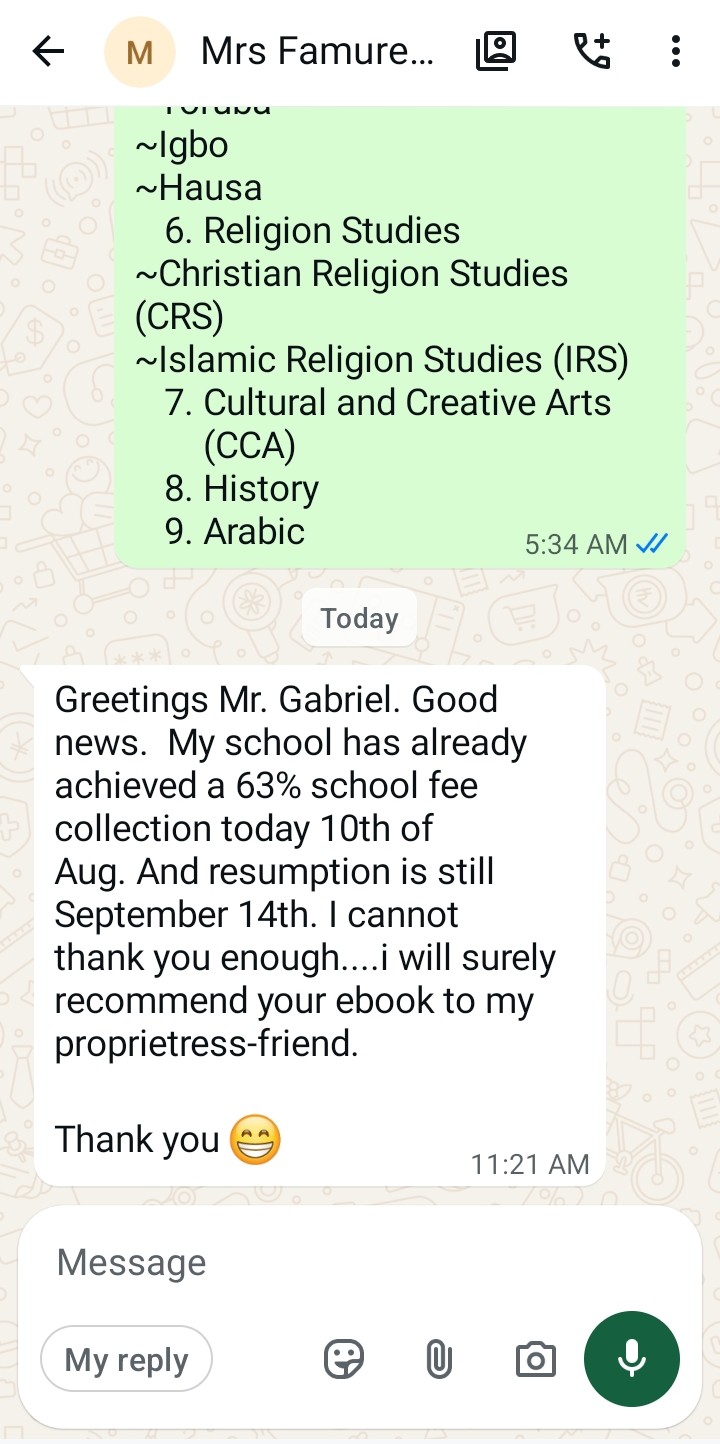
"For years, I chased defaulters myself. My bursar was a good man but a weak collector. We had ₦12 million in outstanding fees. Gabriel's system gave me the structure, the scripts, and the confidence to change our entire culture. This term, we started with ₦8 million in the bank before resumption. The system works."
— Mr. Ademuwagun, School Owner, Lagos
WHAT IS PREDICTABLE CASH FLOW WORTH TO YOUR SCHOOL?
Think about what one delayed payment costs you: borrowing charges, lost supplier discounts, emergency purchases, postponed repairs, staff hours spent chasing, teacher dissatisfaction, reduced buying power.
Now think about what recovering or collecting even one outstanding balance earlier would protect.
You're not buying information. You're investing in a collection system your school can run every single term.
Get the complete guide and implementation toolkit for ₦10,000
Click on Buy Now Button
FREQUENTLY ASKED QUESTIONS
Will this make every parent pay before resumption?
No system can guarantee that. What it does is remove your school's internal weaknesses, get you communicating earlier, structure real payment options, document commitments, and follow up consistently, so payment behaviour improves and uncontrolled debt drops over time.
Will it work for a small school?
Yes. You don't need software. Bank transfers, WhatsApp, SMS, printed agreements and a well-kept spreadsheet are enough to run the core system.
Will it work for parents who are traders or informal earners?
Yes, that's specifically addressed. It shows you how to structure advance contributions and realistic schedules without letting the arrangement turn into indefinite debt.
Does it include actual messages to send parents?
Yes. Templates for invoices, reminders, phone follow-up, payment promises, broken promises, final demands, adjustments, settlements and more, ready to customise with your school's name, amounts and policy.
Does it include a fee policy?
Yes, a detailed model policy covering deadlines, payment options, instalments, advance contributions, disputes, hardship, late payment, broken arrangements, re-enrolment, confidentiality and debt recovery. Adapt and review it for your school before use.
Can the forms be filled electronically?
Yes, the toolkit has fillable form fields you can complete in Adobe Acrobat Reader or another PDF app that supports interactive forms.
Is this an aggressive approach?
No. It's firm, fair and predictable, built to help your school collect what it's owed without humiliating pupils, publishing debtor lists, or wrecking parent relationships.
Can I use the templates in my school?
Yes, customise and reproduce them for internal use in your own school. They may not be resold, distributed publicly, or shared with other schools.
How fast can we implement it?
The guide includes a structured 30-day rollout plan and workbook to take you from diagnosis to launch.
THE NEXT TERM IS ALREADY APPROACHING
Every term you delay fixing this, the same pattern gets more established. Parents learn deadlines are flexible. Old debt rolls into the next term. Staff keep depending on uncertain salaries. Management keeps spending time chasing money the school already earned.
Don't wait until salaries are due to start collecting.
Don't let verbal promises replace written plans.
Don't let private exceptions undercut your bursar.
Don't let a child carry an adult's debt.
Build a system parents understand, staff can run, and management can measure.
Get the complete guide and implementation toolkit for ₦10,000
Get Instant Access on Selar →
How to Collect School Fees on Time — Firm. Fair. Predictable.
Zero-Risk Guarantee
I want your school to collect fees on time more than I want your ₦10,000.
That's why I'm offering a 60-Day, No-Questions-Asked Money-Back Guarantee. If you implement the system for a full term and don't see a measurable improvement in your pre-resumption collections, simply send me an email, and I'll refund every naira.
No forms, no questionnaires, no hassle.
Bonus
As a launch price, this is available at ₦10,000. This price is set to increase to ₦30,000 once we reach a sample size of testimonials.
You may likely have some of these pieces. An invoice here, a WhatsApp group there.
But pieces don't make a system.
This guide connects the dots. It takes what you're already doing, structures it, and turns your reactive chasing into a predictable, proactive machine.
Stop spending hours on patchwork fixes.