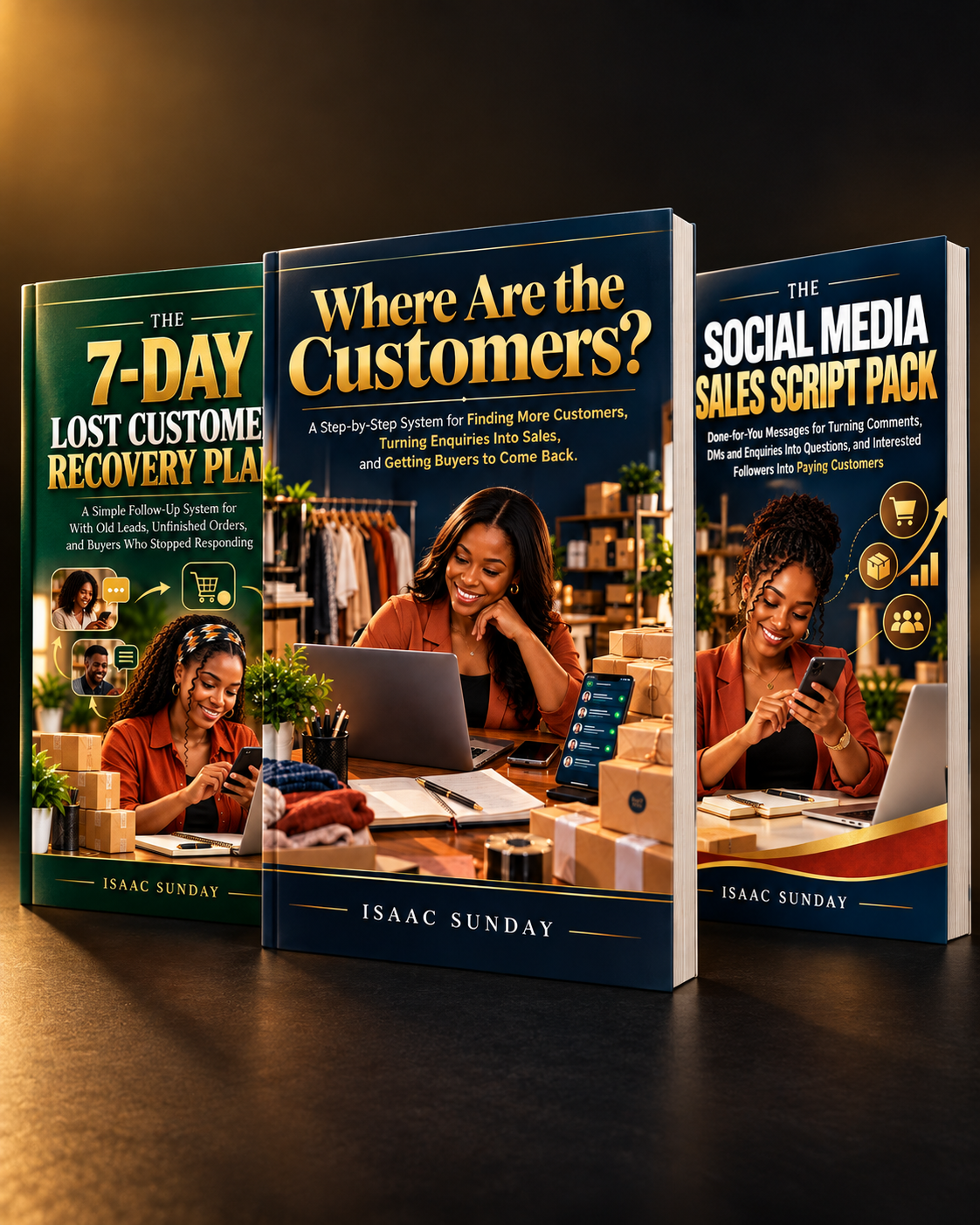
Where Are The Customers?
WHERE ARE THE CUSTOMERS?
A 7-Step Sales Letter for Nigerian Small-Business Owners
You Have a Business. You Have Something Worth Selling. So Why Does Finding Customers Still Feel This Difficult?
You opened your business to make sales, not to spend every week wondering where the next customer will come from.
Maybe you have a physical shop.
Maybe you sell from home.
Maybe you provide a service.
Maybe customers find you through referrals, WhatsApp, Instagram, Facebook, Google, marketplaces, agents, walk-ins, networking, or word of mouth.
Maybe you use several of them.
But despite all the effort, sales still feel unpredictable.
Today, someone asks for your price.
Tomorrow, another person promises:
“I’ll come back.”
Someone requests a quotation.
Another person asks for your account details.
A potential customer says:
“Let me think about it.”
Then...
Nothing.
And before long, you are back looking for another customer.
Does This Sound Like Your Business?
You promote your business but don't get enough serious enquiries.
People ask questions but many don't buy.
You get referrals occasionally, but you can't depend on when the next one will come.
People visit your shop, collect your number, or ask for your price and disappear.
You send quotations but don't always follow up.
You have old enquiries sitting in your phone that you haven't contacted again.
Previous customers bought from you once, but you have no system for bringing them back.
You run promotions, get a temporary increase in activity, then things become quiet again.
And every month, it feels like you have to go out and start looking for customers all over again.
If that sounds familiar, pay attention.
Because the problem may not simply be:
“I need more customers.”
There may be something deeper happening.
You May Be Losing Customers at Several Different Points Without Realizing It
Think about this.
What happens when somebody discovers your business?
What happens when they ask for the price?
What happens when they say your price is too high?
What happens when they request a quotation but don't respond?
What happens when someone says:
“I'll come back next week.”
Who follows up?
What happens after someone buys from you?
Do you have a reason to contact that customer again?
Do you know which marketing channel actually brought your last ten customers?
Or are you simply promoting your business and hoping something works?
That is where the real problem begins.
Because getting attention is not the same as getting paid.
A person walking into your shop is not yet a customer.
A person asking for your price is not yet a customer.
A WhatsApp enquiry is not yet a customer.
A referral is not yet a customer.
A person requesting your account details is not yet a customer.
A quotation sent is not yet a sale.
There is a journey between someone discovering your business and money actually entering your account.
And many small businesses don't have a clear system managing that journey.
So they keep trying to solve everything by looking for more people.
More posts.
More flyers.
More advertising.
More promotions.
More referrals.
More discounts.
But if interested people are already slipping through the cracks, bringing in more people doesn't automatically fix the problem.
Imagine pouring water into a leaking bucket.
You can keep pouring faster.
Or you can first find the holes.
That's why your business needs more than promotion.
It needs a customer system.
What If You Could Stop Treating Every Sale Like Luck?
Instead of waking up and wondering:
“Where will today's customers come from?”
Imagine having a clearer process for answering five important questions:
1. WHERE CAN I FIND THE RIGHT CUSTOMERS?
Not everybody is your customer.
You need to understand who is most likely to need what you sell and where those people can realistically be reached.
That could be through referrals.
A physical location.
Partnerships.
Google.
Community networks.
WhatsApp.
Social media.
Marketplaces.
Existing contacts.
Offline marketing.
Or a combination of channels.
2. HOW DO I GET THEM INTERESTED?
Getting in front of people isn't enough.
Your offer needs to give the right person a reason to stop and consider buying.
3. HOW DO I TURN INTEREST INTO A SALE?
What happens after someone asks a question matters.
How you explain your product or service matters.
How you respond to uncertainty matters.
How you communicate value matters.
4. WHAT HAPPENS IF THEY DON'T BUY IMMEDIATELY?
This is where many potential sales simply disappear.
No record.
No reminder.
No follow-up.
Just another forgotten conversation.
5. WHAT HAPPENS AFTER THEY BUY?
A customer who already knows your business shouldn't automatically become a stranger again after making one purchase.
There should be a process for checking in, supporting them, encouraging an appropriate repeat purchase, and requesting referrals when it makes sense.
Put those five pieces together and you get:
FIND → ATTRACT → CONVERT → FOLLOW UP → BRING BUYERS BACK
That is the customer system.
And that's exactly what this guide was created to help you build.
WHERE ARE THE CUSTOMERS?
A Step-by-Step System for Finding More Customers, Turning Enquiries Into Sales, and Getting Buyers to Come Back
Where Are the Customers? is a practical business guide created for Nigerian small-business owners who want a clearer way to find, convert, follow up with, and retain customers.
Whether you run your business:
Online.
Offline.
From a physical shop.
From home.
Through referrals.
Through social media.
Through direct selling.
Or through several channels at once.
The principle remains the same:
Your Business Needs a Repeatable Way to Get and Keep Customers.
Inside the main guide, you'll learn how to:
✓ Identify where potential customers may be dropping out of your current process
✓ Define the customers most likely to need what you sell
✓ Find realistic places and channels where those customers can be reached
✓ Choose your strongest customer-acquisition channels instead of trying everything at once
✓ Strengthen your offer before blaming your marketing
✓ Make your marketing and content more purposeful
✓ Handle enquiries as buying conversations instead of simply answering questions
✓ Follow up with genuine prospects without sounding desperate
✓ Build customer sources beyond one platform or method
✓ Make your business easier for new customers to trust
✓ Turn first-time buyers into opportunities for repeat business
✓ Track the numbers that tell you what is actually working
✓ Build a practical 30-day customer routine
And instead of leaving you with theory, the guide gives you practical tools to work with.
THE 20-MINUTE CUSTOMER LEAK AUDIT
Find the points where potential customers may already be slipping away.
THE IDEAL CUSTOMER FINDER
Get clearer about exactly who you're trying to attract.
THE CUSTOMER CHANNEL SCORECARD
Compare possible customer sources and decide where your effort is better spent.
THE LEAD FOLLOW-UP TRACKER
Stop relying on memory to remember who asked, who promised to return, and who needs another conversation.
THE BUYER TRUST CHECKLIST
Identify missing information that may be making new customers hesitate.
THE 7-DAY CUSTOMER-FOCUSED CONTENT PLANNER
For businesses using digital channels, give your content a specific purpose instead of posting randomly.
THE 30-DAY CUSTOMER SYSTEM TRACKER
Track enquiries, sales, conversion, customer sources, repeat purchases and other useful numbers so you can make decisions using what is actually happening in your business.
But Finding Customers Is Only the Beginning...
Suppose someone finally shows interest.
They message you:
“How much?”
Or:
“What's your last price?”
Or:
“Let me think about it.”
Or:
“I'll get back to you.”
What do you say next?
For businesses that communicate with customers through WhatsApp, Instagram, Facebook and other digital channels, this is where the first bonus becomes useful.
BONUS #1: THE SOCIAL MEDIA SALES SCRIPT PACK
Ready-to-Use Messages for Common Customer Conversations
This supporting guide helps you communicate more effectively when potential customers contact your business digitally.
You'll have practical message frameworks for situations involving:
✓ Price enquiries
✓ New leads
✓ Product or service questions
✓ Price objections
✓ Interested prospects
✓ Follow-ups
✓ People who stop responding
✓ Common buying conversations
Instead of staring at the screen wondering:
“What should I reply?”
You have a framework you can adapt to your own business.
BONUS #2: THE 7-DAY LOST CUSTOMER RECOVERY PLAN
Because Some of the Customers You're Looking for May Already Know Your Business
This is important.
Before you spend another week chasing completely new people, think about the opportunities you've already generated.
Someone visited your shop and promised to return.
Someone called after receiving your number from a friend.
Someone requested a quotation.
Someone asked about your service but didn't proceed.
Someone sent you a WhatsApp message.
Someone started placing an order but didn't complete it.
Someone bought from you before and hasn't returned.
How many of these people have you deliberately followed up with?
The 7-Day Lost Customer Recovery Plan gives you a structured process for revisiting:
✓ Old leads
✓ Previous enquiries
✓ Unfinished orders
✓ Quotations that went quiet
✓ Prospects who promised to return
✓ Previous customers
✓ Other genuine opportunities that were never properly followed up
Whether the original interaction happened online or offline, the principle is the same:
Don't automatically forget someone simply because they didn't buy immediately.
SO HERE'S YOUR COMPLETE CUSTOMER SYSTEM
📘 WHERE ARE THE CUSTOMERS?
Find → Attract → Convert → Follow Up → Retain
Your main customer acquisition, conversion and retention system.
📗 THE SOCIAL MEDIA SALES SCRIPT PACK
Know what to say during digital customer conversations.
Your supporting communication resource for WhatsApp, social media and other online enquiries.
📙 THE 7-DAY LOST CUSTOMER RECOVERY PLAN
Go back to opportunities you've already created.
Your structured system for old leads, unfinished sales and previous customers.
3 PRACTICAL GUIDES. 1 CUSTOMER SYSTEM.
How Much Longer Can Your Business Afford to Keep Starting From Zero?
This isn't about creating fake urgency.
It's about what may already be happening inside your business.
Every week you operate without a clear customer process, another genuine enquiry can be forgotten.
Another quotation can go without follow-up.
Another person can say:
“I'll come back.”
And nobody contacts them again.
Another customer can buy once and disappear from your business completely.
Another promotion can end without you knowing exactly what worked.
Another month can finish with you saying:
“Business was just slow.”
But without knowing why.
And that is the dangerous part.
Because when you don't know where customers come from, where prospects are dropping off, why people hesitate, or which activities actually lead to sales, it's difficult to know what to improve.
So you do what many business owners do.
You work harder.
You advertise again.
You reduce the price.
You run another promotion.
You tell more people.
You post more.
But you're still guessing.
You Don't Need Another Month of Guessing.
You need a process you can test.
A process you can measure.
A process you can improve.
And a process you can repeat.
Not because any guide can guarantee that every prospect will buy.
It can't.
Your results will still depend on your product, service, pricing, demand, competition, customer experience and how well you execute.
But you can stop running your customer acquisition entirely on hope.
YOUR NEXT CUSTOMER SHOULDN'T ALWAYS FEEL LIKE A MYSTERY.
Whether you run a salon in Lagos...
A fashion business in Aba...
A restaurant in Abuja...
A printing business...
A provision store...
A photography business...
A repair service...
A bakery...
A consulting business...
A home-based business...
An online store...
Or another Nigerian small business...
One thing remains true:
Without Customers, There Is No Business.
You need people to discover you.
You need the right people to become interested.
You need interested people to buy.
You need a process for following up with those who aren't ready immediately.
And after someone buys, you need a reason for that relationship to continue.
So stop depending entirely on:
PROMOTE → WAIT → HOPE → START AGAIN
Start building:
FIND → ATTRACT → CONVERT → FOLLOW UP → BRING BUYERS BACK
When you get access, you'll receive:
📘 Where Are the Customers?
The complete customer system.
📗 The Social Media Sales Script Pack
Ready-to-use frameworks for digital customer conversations.
📙 The 7-Day Lost Customer Recovery Plan
A structured system for reconnecting with old leads, unfinished opportunities and previous customers.