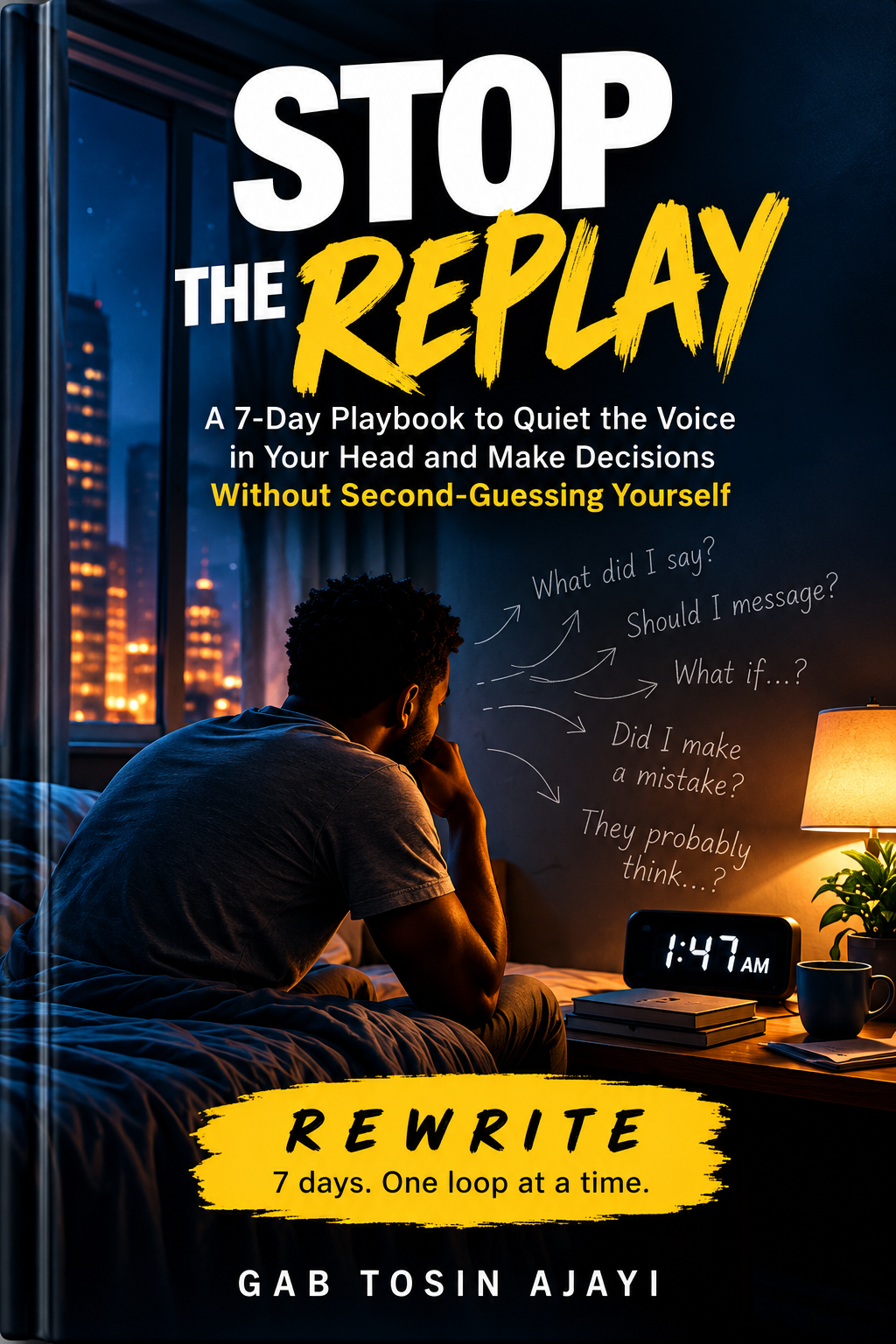
Stop The Replay: A 7-Day Playbook to Quiet the Voice in Your Head and Make Decisions Without Second-Guessing Yourself
For The Person Who Is Still Awake, Replaying Something They Said At 3 P.M
Stop Replaying Yesterday at 1:47 a.m.
Here is a 7-day, 10-minutes-a-day playbook, built on one simple method called REWRITE, to quiet the voice in your head and make decisions without second-guessing yourself.
Plus 5 ready-made tools, and a 30-day money-back promise.
Get the Playbook + All 5 Bonuses, [PRICE]
The Letter
Dear friend,
Let me describe a scene. See if it sounds familiar.
It’s 1:47 in the morning. The house is quiet. Your phone says it’s way too late to still be awake.
And you are lying there in the dark, replaying a sentence you said at three o’clock yesterday.
Not a big sentence. Maybe seven words. But your mind has played it forty times now. You’ve changed your tone. You’ve imagined their face. You’ve written six better replies you’ll never send.
Here’s the strange part.
Nobody else remembers it.
Only you.
And here is the cruel joke: the more you replay it, the bigger it gets.
If you just nodded, keep reading. This page was written for you.
First, Something You Need to Hear Before Anything Else
You are not broken.
You are not weak. You are not dramatic. And you are not “just an overthinker” in the sense of some flaw you were born with.
Your mind learned a trick a long time ago.
The trick is to rehearse. Replay what happened. Run through what might happen. Check it. Check it again. And hope that if you think about it enough, you will finally be safe from embarrassment, rejection or regret.
That trick feels like protection. It isn’t.
What Your 1:47 a.m. Replay Is Really Costing You (It’s More Than Sleep)
Let me be blunt, because I think you can take it.
The replay costs you sleep.
The nights you should be resting, you’re in a courtroom in your own head.
It costs you decisions.
The email you haven’t sent.
The offer you haven’t answered.
The proposal sitting in your drafts for five weeks because you’ve opened it fourteen times and changed one comma.
It costs you opportunities.
Not because you’re not good enough, but because by the time you’ve finished thinking, somebody else has said yes.
And it costs you something harder to name.
The quiet feeling that you can’t trust your own judgment.
That last one is the expensive one.
Let me show you why none of the usual advice touches it.
Why “Just Stop Thinking About It” Has Never Worked (And Why That’s Not Your Fault)
You’ve probably been told to “just stop thinking about it.”
How did that go?
You’ve probably been told to “be more confident.” To “stop being so hard on yourself.” To “just make a decision.”
And every time it didn’t work, you quietly decided there was something wrong with you.
Think about that for a second.
There isn’t.
Here’s what’s actually going on.
Replaying feels like problem-solving, but it isn’t.
When you replay a conversation, the conversation is over.
You can’t change it.
No new information is going in, so nothing new can come out.
You’re just watching the same clip again, hoping it’ll end differently.
It’s not a willpower problem. It’s a loop. And a loop needs a different kind of tool.
A well-known Harvard study found that people’s minds were wandering away from what they were doing nearly half the time, and that when their minds wandered, they reported being less happy.
Where your attention goes matters.
That’s the good news. Attention can be trained.
So I Built You Something to Do at 1:47 in the Morning
Here’s what I noticed about the advice you’ve probably been given.
None of it tells you what to do at 1:47 in the morning, with your heart beating and a sentence from yesterday playing on a loop.
It tells you to stop. It never gives you something to do instead.
That’s like telling a drowning man to stop splashing.
So I wrote a playbook around one method. I call it REWRITE, because that is exactly what you’re doing.
You’re not fixing a broken brain. You’re rewriting a habit that was written long ago.
The playbook is called Stop the Replay: A 7-Day Playbook to Quiet the Voice in Your Head and Make Decisions Without Second-Guessing Yourself.
It is not a lecture. It is not a 400-page book you’ll start on Sunday and abandon by Wednesday.
It is seven short chapters. One a day.
Each one takes about 15 minutes to read and under 10 minutes to act on.
One idea. One small action.
And a way to see, in your own handwriting, whether anything is actually changing.
I’m not asking you to take my word for it. Further down this page, I’ll show you exactly how the method works, so you can judge it for yourself.
Here’s the Whole Week, Day by Day (Seven Small Actions, About Ten Minutes Each)
Day 1: Recognize. The Replay Has a Name.
You catch the loop in the act and count it
Most people discover they do it way more often than they thought. (In the book, Chika finds eleven in a single day.) Y
ou can’t change what you can’t see, and by tonight, you’ll see it.
Day 2: Expose. Why Replaying Feels Smart and Isn’t.
You learn a five-second test that tells you whether a thought is useful or just a loop.
You also count what the replay has really been costing you.
It’s uncomfortable. It’s also the moment most people stop treating overthinking as a virtue.
Day 3: Witness. Fire the Prosecutor.
There’s a voice in your head that treats every mistake like evidence in a trial.
On Day 3 you’ll learn to swap it for a calm coach, using a simple technique you can try in a few minutes. (Hint: it involves using your own name. It feels odd. Do it anyway.)
Day 4: Rule. Good Enough Is a Superpower.
Certainty isn’t for sale, so stop trying to buy it.
You’ll set a deadline for every decision, learn the 70% rule for low-stakes choices, and start a simple Decision Log that lets you close the file instead of reopening it at 2 a.m.
Day 5: Interrupt. The 2 a.m. Rescue Plan.
The old loop will come back. Better you know that now.
You’ll write a four-step rescue card, short enough to follow half asleep, so that when it comes you’re not starting from scratch.
Day 6: Take action. The Bold Move.
You stop practicing and start proving.
You’ll pick the one decision
you’ve been dodging and take it, or its first visible step, with a simple “prediction check” that lets you compare what you feared with what actually happened.
Some of my favorite pages in the book are about that gap.
Day 7: Embody. The New Normal.
You lock it in. You’ll write an identity statement in your own words, collect your wins, and set up a 15-minute weekly check-in that keeps the whole thing alive long after Day 7.
Here’s What You’ll Discover Inside
- The one question that tells you in seconds whether a thought is worth thinking or just a loop. (Day 2)
- Why talking to yourself in the third person can take the edge off a stressful moment, and exactly how to do it. (Day 3)
- The deadline scale for small, medium and big decisions, so you never again let a ten-minute choice eat three weeks. (Day 4)
- A simple question to ask yourself to tell whether a decision is easy to undo. (Hint: more of them than you think are.) (Day 4)
- The four-step rescue card you can read half asleep when the loop starts at 2 a.m. (Day 5)
- Why trying hard not to think about something often backfires, and what to do with your body and attention instead. (Day 5)
- The prediction check that shows you how big your fear really was after you’ve done the thing. (Day 6)
- A 15-minute weekly check-in that keeps the change from fading by Friday. (Day 7)
Here’s the Part Most Books Skip
Here’s a confession.
Most self-help books give you good ideas and then leave you alone with them.
You close the book. You feel inspired. Then it’s 2 a.m. on Thursday, the loop starts, and you can’t remember what chapter 4 said. Or you forget to do the daily action. Or you never find out whether any of it is working.
Knowing what to do and doing it are two very different things.
So I didn’t want to hand you just a book. I wanted to take away every excuse between you and the practice. Every place where people usually get stuck, I built a tool for.
Each of these is a ready-to-use file. Nothing to design, nothing to figure out. Print it, fill it in, or put it on your phone.
You Also Get These 5 Bonuses (Included at No Extra Cost)
Bonus 1: The Replay Rescue Sheet
Solves: the 2 a.m. loop.
One page with the 4-step rescue (Name it, Move it, Write it, Close it), the three questions to ask yourself, and your decision rules. At 2 a.m. you don’t have to think or remember anything. You just read four lines. Print it and tape it beside your bed, or save the phone image as your lock screen.
Bonus 2: The Before vs. After Tracker
Solves: “Is this working?”
A fillable Day 1 to Day 7 tracker. Two minutes each night. By Day 7 you can put your first column next to your last one and see, in your own handwriting, whether anything moved. No guessing, no relying on how you feel.
Bonus 3: The Decision Log Template
Solves: reopening closed decisions.
A clean log with date, decision, reason and status, plus your “Already decided” sentence. When the old voice says “but what if the other one was better?”, you open the log and see that you already decided, and why.
Bonus 4: The REWRITE Weekly Check-In
Solves: sliding back after Day 7.
A one-page version of the 15-minute weekly routine: Review, Reward, Reset, Rule the week. A fillable sheet, the same every week, so keeping the habit takes minutes and no planning.
Bonus 5: The 7-Day Reminder Calendar
Solves: forgetting to do the daily actions.
One-line prompts for every day of the playbook, plus a small builder that creates a calendar file for your phone. Pick your start date, download the file, open it, and the right prompt shows up on the right day. You don’t have to remember the plan. Your phone does.
Here’s why these exist. The playbook tells you what to do. The bonuses make it easy to actually do it, and to keep doing it. Less setup, less figuring out, less friction between you and the next small action.
Don’t Take My Word for It. Check the Mechanism.
I’ll be straight with you. This book is brand new. There are no reviews yet, and I won’t invent any.
So instead of asking you to trust other people’s opinions, I’m asking you to look at how it works and judge it for yourself.
Every day of the playbook is one step of one method. The first letters spell REWRITE:
- Recognize. You catch the replay and count it. You can’t change what you can’t see.
- Expose. You see that replaying isn’t wisdom, and you count what it costs you.
- Witness. You swap the harsh inner prosecutor for a calm coach.
- Rule. You set a deadline, use the 70% rule for low-stakes choices, and close each decision in a log.
- Interrupt. You write a four-step rescue card before the loop returns.
- Take action. You make one real move and compare what you feared with what happened.
- Embody. You write your identity statement and set up a 15-minute weekly check-in.
Here’s what makes it different from “just stop overthinking”:
- The order is deliberate. You see the loop before you try to change it. You learn the rule before you need it. You write the rescue plan before the first slip. Each day builds on the one before.
- It replaces the loop instead of fighting it. Telling yourself “stop thinking about it” often backfires. The playbook gives your mind something to do instead: label it, move your body, write it down, close it.
- It uses decisions made in advance. Your if-then plans and rescue card are written while you’re calm, so at 2 a.m. you only have to read four lines.
- It gives you proof from your own life. The nightly tracker and the Day 6 prediction check put your fear next to what actually happened, in your own handwriting.
- The five bonus tools remove the friction. The rescue sheet, tracker, log, check-in and reminder calendar are already made, so nothing gets in the way of doing the work.
The ideas underneath are drawn from psychology research on rumination, self-talk, self-compassion, decision-making and if-then planning.
I explain each one in plain language, with sources listed at the back of the book.
I should be clear about the limit: the REWRITE sequence itself is my own way of putting those ideas together. The research behind the individual ideas is real, but the studies didn’t test this exact seven-day program as a package.
So don’t ask “Do these people like it?” Ask “Does this make sense for how my mind works?” You can read how the mechanism works and decide whether it fits. If it does, try it for a week. If it doesn’t, you’re covered by the guarantee below.
An Honest Word About What This Is (and Isn’t)
I’m not going to promise you a silent mind. Nobody gets one, and you don’t need one.
I’m not going to tell you this will change your life if you only read it. It won’t. Reading changes nothing. Doing does.
That’s why every action in the playbook is small enough to finish in under ten minutes, with the exact words to use, and why I built the five tools above to make the doing as easy as I could.
And I’m not going to tell you this is therapy or medical advice. It’s not. It’s a practical self-help playbook built on well-studied ideas from psychology, explained in plain language.
If your worry feels constant or overwhelming, or is getting in the way of sleeping, working or eating, please talk to a doctor or a qualified counselor. This can work alongside that kind of help.
What I am promising is this: if you do the seven small actions, you will have a plan for the hard nights, a rule for the hard choices, and a record, in your own handwriting, of what you tried and what you noticed.
That’s real. And it’s more than most people ever give themselves.
This Is For You If...
- You replay conversations long after they’re over.
- You second-guess decisions, then second-guess the second-guessing.
- You’ve got something sitting in your drafts, your inbox or your head that you keep “thinking about.”
- You talk to yourself in a way you’d never talk to a friend.
- You’re tired of being tired from your own mind.
- You want something practical, short and simple, with the tools already made.
This Is NOT For You If...
- You want a book to read and never apply.
- You’re looking for a quick fix with no effort. (Ten minutes a day is the effort.)
- You want a substitute for professional care. This isn’t one.
Who Is Writing You This Letter?
I’m a perspective shift coach, and I help people stop pouring all their attention into the problem, the challenge or the painful experience, and start looking at the solution, the lesson and the way out.
What you focus on grows, so I teach you to look at your struggle just long enough to learn from it, then turn toward the actions that move you forward.
My goal is not to promise you a life without hard days, but to help you stop circling what has kept you stuck and start moving toward what’s possible.
Here’s Everything You Get Today
No mystery, no upsells hiding behind a button. Here is exactly what’s in the box.
The Main Playbook
Stop the Replay: A 7-Day Playbook to Quiet the Voice in Your Head and Make Decisions Without Second-Guessing Yourself. Seven short daily chapters (about 15 minutes to read, under 10 minutes to act).
Plus 5 Bonuses
- Bonus 1: The Replay Rescue Sheet (the 2 a.m. loop)
- Bonus 2: The Before vs. After Tracker (“Is this working?”)
- Bonus 3: The Decision Log Template (reopening closed decisions)
- Bonus 4: The REWRITE Weekly Check-In (sliding back after Day 7)
- Bonus 5: The 7-Day Reminder Calendar (forgetting the daily actions)
Price: 5000
30-day money-back guarantee. If it doesn’t deliver what I promised, email me and you get your money back.
Delivery is quick : “Instant digital download after checkout. Printable PDFs, a phone image and a calendar builder, all in one download.”
My 30-Day Promise
Here is the deal, in plain words.
Get the playbook. Read it. Do the seven daily actions. Use the tools.
If, within 30 days of your purchase, you feel the book, the guide or the system didn’t deliver what I told you it would, email me at [email protected] and I’ll refund your purchase.
You don’t need to prove anything or fill in a form. If you’re not satisfied, you get your money back.
I’m comfortable making that promise because the playbook only asks for about ten minutes a day, and the worst case is that you spend one week trying something and then get your money back.
I’ll process your refund within 2 business days.
Questions You Might Be Asking
“What if I’m not satisfied?” Email me at [email protected] within 30 days of your purchase and I’ll refund you. You don’t need to prove anything. The full terms are in “My 30-Day Promise” above.
“Why should I trust this when there are no reviews yet?” You shouldn’t have to. That’s why I show you how the method works instead of quoting people, and why there’s a 30-day guarantee. Read the mechanism section, decide whether it makes sense for how your mind works, and try it for a week. If it doesn’t, you get your money back.
“I’ve tried everything. Why would this be different?” Maybe it won’t be, and I won’t pretend otherwise. But most advice tells you to stop the thought. This playbook gives you a small, specific action for every single day, and a ready-made tool for the hard moments, so you’re never left guessing what to do next. If you’ve never had a plan for the hard nights, you’ve never had a fair test.
“I don’t have time.” You have fifteen minutes to read and ten to act. That’s less time than one good replay. And the bonuses are already made, so there’s nothing to set up.
“Do I have to make my own tracker, log and rescue card?” No. They’re all included, ready to print or fill in. Open the file and use it.
“Is this therapy?” No. It’s a self-help playbook. It’s not medical advice, and it doesn’t replace professional care. If you’re struggling, please speak to a doctor or qualified counselor.
“Will it work for me?” I can’t promise a result. Everyone’s life is different. What I can tell you is that the playbook is built on ideas that have been studied by psychologists, turned into small daily actions, and backed by tools that make the actions easy. If you do the actions, you’ll find out. If you only read it, you won’t.
“What if I miss a day?” Then do the next one. Day 5 is literally about slips. Missing a day isn’t failure. It’s Tuesday.
“How do I get it?” Delivery is quick : “Instant digital download after checkout. Printable PDFs, a phone image and a calendar builder, all in one download.”
One Last Thing
You’ve spent a long time inside the replay. You’ve been carrying a weight nobody could see, and you’ve been doing it while still showing up for your work, your family and your life.
That isn’t weakness. That’s strength with nowhere useful to go.
Let’s give it somewhere to go.
Somewhere out there is the version of you who sleeps through the night, sends the message without rereading it, makes the call and moves on, and walks through an ordinary Tuesday without a war in their head.
That person isn’t a stranger. That person is you, with a week of practice behind you.
So here is my question.
Will tonight be one more night in the courtroom? Or the first night you walk in with a plan?
Yes, I Want the Playbook + All 5 Bonuses
Tonight could be different.
Yours,
Gab Tosin Ajayi
P.S. Day 1 takes about five minutes of actual doing. By tonight you’ll know exactly how often the replay shows up. Many people are surprised. And you can’t change what you can’t see.
P.P.S. Tonight, when it’s 1:47 and the loop starts, you’ll do one of two things. You’ll replay it again, or you’ll have a plan. You choose.
P.P.P.S. This book is new, so I can’t show you reviews. What I can show you is the method, and I’ve put the whole thing on this page. Read it. If it makes sense, try Day 1 tonight. It takes about five minutes. And if it’s not for you, the 30-day promise has you covered.