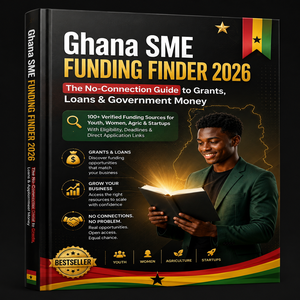
GHANA SME FUNDING FINDER 2026
GHANA SME FUNDING FINDER 2026
STOP SEARCHING BLINDLY FOR BUSINESS FUNDING.
Discover the Grants, Loans & Funding Programmes That Could Be Relevant to Your Ghanaian Business—and Learn How to Prepare Yourself to Apply.
You don't necessarily need another motivational speech.
You need to know:
Where is the funding?
Who qualifies?
How much is available?
When does the opportunity open or close?
Where do I apply?
What documents do I need?
How do I prepare a stronger application?
Ghana SME Funding Finder 2026 was created to help you answer those questions.
GET THE FUNDING FINDER — GH₵111
ARE YOU TIRED OF HEARING...
"There is a grant available."
But nobody tells you where to apply?
You see funding opportunities on Facebook and WhatsApp.
You click the link.
You're not sure if it's genuine.
You ask someone.
They tell you:
"You need connection."
You try an application.
Nothing happens.
And eventually you conclude:
"Funding is not for people like me."
But the book argues that the real problem is often the information jungle: funding information is scattered across government portals, institutional announcements, donor programmes and application guidelines.
Ghana SME Funding Finder 2026 was created to bring that information together into a practical finder tool.
WHAT IF YOU COULD STOP CHASING EVERY FUNDING POST YOU SEE?
Instead, imagine having a structured map showing the major funding routes you should investigate.
THE 7 FUNDING HIGHWAYS
The book organizes funding into seven broad routes:
1. GRANTS
Funding that generally does not require repayment, although opportunities can be highly competitive.
2. CONCESSIONAL LOANS
Lower-cost financing routes for eligible businesses.
3. GOVERNMENT PROGRAMMES
Including programmes associated with institutions such as GEA and NEIP.
4. YOUTH OPPORTUNITIES
Funding programmes specifically designed around eligible young entrepreneurs.
5. WOMEN'S FUNDING OPPORTUNITIES
Routes specifically targeting eligible women entrepreneurs.
6. AGRICULTURE & AGRIBUSINESS
Funding opportunities for farming, processing and other agricultural businesses.
7. STARTUP, NGO & INTERNATIONAL FUNDING
Opportunities connected to international organizations, foundations and development programmes.
WHAT'S INSIDE GHANA SME FUNDING FINDER 2026?
100+ FUNDING OPPORTUNITIES
Instead of making you search randomly across the internet, the book presents a large collection of funding opportunities with information such as:
✓ Funding source
✓ What the programme is
✓ Potential funding amount
✓ Who may qualify
✓ Application/deadline information
✓ Relevant application links
One book. One funding map. Multiple routes to investigate.
GOVERNMENT FUNDING WITHOUT THE "WHO DO YOU KNOW?" APPROACH
The book has an entire section dedicated to the Government Funding Highway, covering programmes and institutions including:
GEA
NEIP
YouStart
MASLOC
and other relevant funding routes.
It explains how these programmes work, who they are designed for and what applicants should prepare.
DON'T JUST FIND FUNDING.
GET FUNDING-READY.
One of the biggest mistakes entrepreneurs make is finding an opportunity after the application has opened and then scrambling to gather documents.
This book gives you a 9-document Funding Ready Folder concept so that important documents can be organized ahead of time.
Instead of:
Opportunity opens → Panic → Search for documents → Miss deadline
You can work toward:
Prepare → Organize → Monitor → Apply
🎯 THE 48-HOUR FUNDING SPRINT
The book doesn't simply tell you to "apply for grants."
It gives you an actionable sprint.
HOUR 0–2
Build your MY FUNDING READY FOLDER 2026
HOUR 2–4
Put important funding deadlines into your calendar.
HOUR 4–48
Choose one appropriate opportunity and work toward submitting an application.
Because planning 20 applications isn't the same as submitting one.
📅 YOUR 2026 FUNDING CALENDAR
The book includes a funding-calendar approach covering opportunities and application windows so entrepreneurs can monitor programmes instead of discovering them after the deadline.
It includes examples involving programmes such as TEF, UNDP GEF, NEIP Adwumawura, GEA programmes, develoPPP, MASLOC, EXIM Bank, GIRSAL and KIC.
Important: funding programmes, deadlines and eligibility requirements can change. Always verify the current information with the official programme before applying.
📝 LEARN HOW TO PRESENT YOUR BUSINESS BETTER
Finding the opportunity is only one part of the process.
You also need to communicate your business clearly.
The book demonstrates the difference between a weak, vague funding request and a more structured business case containing:
- Current sales
- Current profit
- Existing production
- Specific equipment required
- Funding amount
- Expected increase in production
- Expected sales
- Expected profit
- Potential jobs created
Don't just tell a funder that you have a dream.
Show them what the money would actually do.
🚨 LEARN HOW TO SPOT FUNDING SCAMS
Not every "grant opportunity" you see online is legitimate.
The book includes a 5-point scam-warning framework, including warning signs such as requests for money before funding, suspicious websites, guaranteed-funding claims and requests to send money through informal channels.
Before you send money, learn what to check.
🔗 STOP SAVING RANDOM FUNDING POSTS
The book also provides a shortlist of important funding and institutional websites, including resources associated with:
- Ghana Enterprises Agency
- NEIP
- YouStart
- TEFConnect
- MASLOC
- Ghana EXIM Bank
- GIRSAL
- Mastercard Foundation
- UNDP Ghana
- Other funding-information resources
WHO IS THIS BOOK FOR?
🇬🇭 GHANAIAN SME OWNERS
If you already operate a business and need capital to expand, this can help you identify funding routes worth investigating.
🚀 STARTUPS & ASPIRING ENTREPRENEURS
If you have a business idea but don't know where funding opportunities can be found, this gives you a structured starting point.
👩🏾 WOMEN ENTREPRENEURS
The book specifically identifies funding routes designed around women entrepreneurs.
👨🏾💼 YOUNG ENTREPRENEURS
It identifies youth-focused funding routes and explains relevant eligibility considerations.
🌾 FARMERS & AGRIBUSINESS OWNERS
Agriculture and agribusiness are treated as their own funding highway because of the range of sector-specific opportunities.
📈 EXISTING BUSINESSES LOOKING TO GROW
Especially businesses that need funding for equipment, expansion, working capital, training or other business-development needs.
THIS IS NOT JUST ANOTHER EBOOK.
USE IT LIKE A FUNDING TOOL.
The book itself tells readers not to approach it like a novel, but as a finder tool.
Keep it on your phone.
Bookmark the opportunities relevant to your business.
Check the official source.
Prepare your documents.
Track deadlines.
Apply.
Then come back and search for the next opportunity.
🎁 YOUR FUNDING TOOLKIT
With the guide, you get access to a practical system built around:
✓ 100+ funding opportunities
✓ 7 funding highways
✓ Funding Ready Folder
✓ 9-document preparation system
✓ Funding/deadline calendar
✓ Application templates
✓ Funding application guidance
✓ Scam-warning checklist
✓ Funding opportunity links
✓ 48-hour action sprint
✓ 30-day Funding Sprint Challenge
The 30-day challenge breaks the process into weekly actions: build your folder, pursue government opportunities, explore special funding windows and investigate international opportunities.
HERE'S THE REAL QUESTION...
IF YOUR BUSINESS NEEDED FUNDING TOMORROW, WOULD YOU KNOW WHERE TO LOOK?
Would you know which funding route fits you?
Would your documents be ready?
Would you know which opportunities are worth investigating?
Would you know where the official application portal is?
Would you know how to explain exactly what the money would do for your business?
If your answer is NO, you need a better system.
YOU DON'T NEED TO CHASE EVERY GRANT.
YOU NEED TO FIND THE RIGHT ONES.
The goal isn't to apply everywhere.
The goal is to identify opportunities that match your business, eligibility, sector and stage, then prepare a proper application.
That's the philosophy behind the Funding Finder.
GET GHANA SME FUNDING FINDER 2026 TODAY
YOUR FUNDING MAP FOR GHANAIAN BUSINESS
ONLY GH₵111
For less than the cost of many unsuccessful attempts at finding funding, you get a practical reference designed to help you:
FIND → FILTER → PREPARE → APPLY → TRACK
ONE GUIDE. 100+ OPPORTUNITIES. MULTIPLE FUNDING ROUTES.
GET GHANA SME FUNDING FINDER 2026 — GH₵111
Stop searching blindly. Start finding funding strategically.
YOUR NEXT FUNDING OPPORTUNITY COULD BE CLOSER THAN YOU THINK.
You don't need to know everyone in Accra.
You don't need to depend entirely on WhatsApp forwards.
You don't need to keep scrolling through random Facebook posts hoping someone shares a genuine opportunity.
You need a map.
Ghana SME Funding Finder 2026 gives you that starting map.