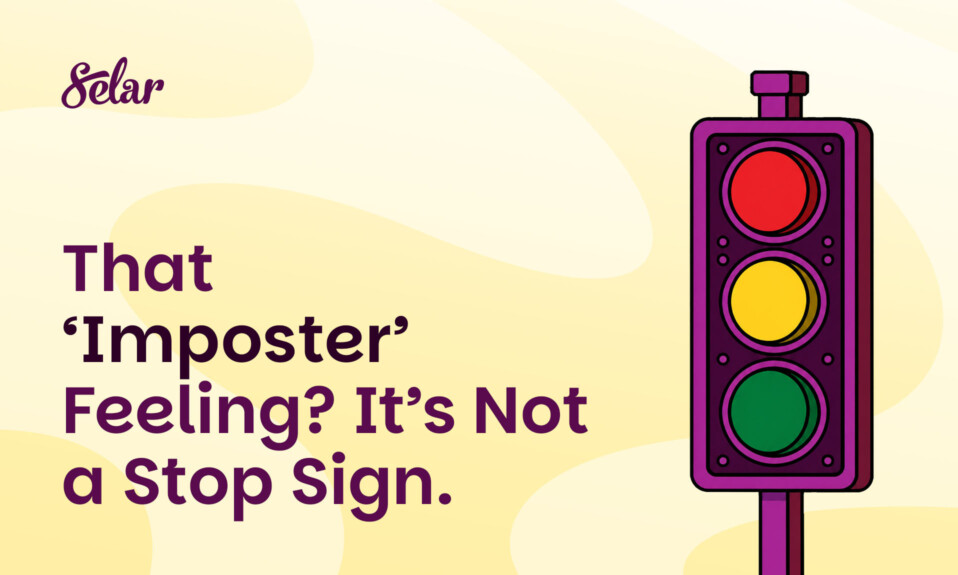
That ‘Imposter’ Feeling? It’s Not a Stop Sign. It’s the Green Light to Launch.
There’s a specific kind of fuzzy feeling that shows up right after you do something that matters. You upload your first course, raise your prices or finally list the product you’ve been sitting on for six months.
And instead of relief, you get a small, nagging voice: ‘Who do you think you are?’
Most creators treat that voice as a problem to fix. It isn’t. It’s usually a signal that you’ve moved somewhere new.
Here’s the truth: Nobody feels like a fraud doing the comfortable thing
Think about the last time you did something that required zero courage.
I’m talking about when you repost a meme, or reply to a comment, and even scrolling instead of creating.
None of it came with a side of dread, because none of it stretched you. Imposter syndrome only shows up at the edge of your comfort zone.
Like the moment you charge for something you used to give away for free, teach something you’re still mastering yourself, or put your name on a product that customers will actually pay for.
That discomfort is a byproduct of stakes, not proof that you don’t belong.
Creators who’ve built real income from what they know describe the same pattern.
In our piece on creators who’ve made real progress selling digital products, almost every one of them talks about doubting themselves right before the version of their offer that actually worked.
The doubt didn’t disappear before they succeeded. It just stopped being in charge.
The mistake is treating the ‘feeling’ as information about your ability
Imposter syndrome feels like insight, but it isn’t.
It’s an emotional reaction to risk, and your brain is not a reliable judge of your own competence in real time, especially not the day after you’ve launched something new.
The useful question isn’t “do I feel ready?” It’s “have I done the work to earn this?”
If you’ve built the product, tested it on real people, and priced it fairly, the feeling of fraudulence is just noise.
Plenty of creators who quit right at this point never find out that the noise would have passed.
This is one of the biggest reasons creators quit before they see results.
The early weeks after a launch are almost always the loudest for self-doubt and the quietest for external validation, because trust and traction take time to build.
Mistaking that lag for failure is what ends most creator businesses, not lack of skill.
What to do instead of waiting for the feeling to pass
- Separate the feeling from the decision.
You don’t need to feel confident to publish, price, or launch. You need the product to be ready. Confidence is often a lagging indicator that shows up after you’ve already done the thing several times, not before.
- Look for evidence, not reassurance.
Reassurance fades in an hour. Evidence doesn’t. Did someone actually use your product and get a result? Did a stranger pay for it without you begging them to? That’s data your feelings can’t argue with.
- Expect the feeling to show up again at every new level.
The creator selling their first ₦20,000 ebook and the creator running a six-figure membership community both deal with some version of this. It doesn’t fully go away. It gets more familiar, and you get faster at moving through it.
Selar removes the parts of “starting” that make imposter syndrome worse.
A lot of what fuels this feeling isn’t really about your ability. It’s about how exposed the process of starting can feel: figuring out how to actually collect payment, deliver a course without it getting pirated, or set a price without a clear sense of what’s normal.
Selar takes that uncertainty off your plate. You can upload a digital product, set your price, and start collecting payment in minutes, in naira or major foreign currencies, without needing a developer, a website, or a payment gateway you have to configure yourself.
When the mechanics are handled, the only thing left to doubt is the work itself, and that doubt is far easier to push through.
You don’t need to feel like an expert to start on Selar. You need one thing worth selling.
Start selling on Selar: selar.com/start