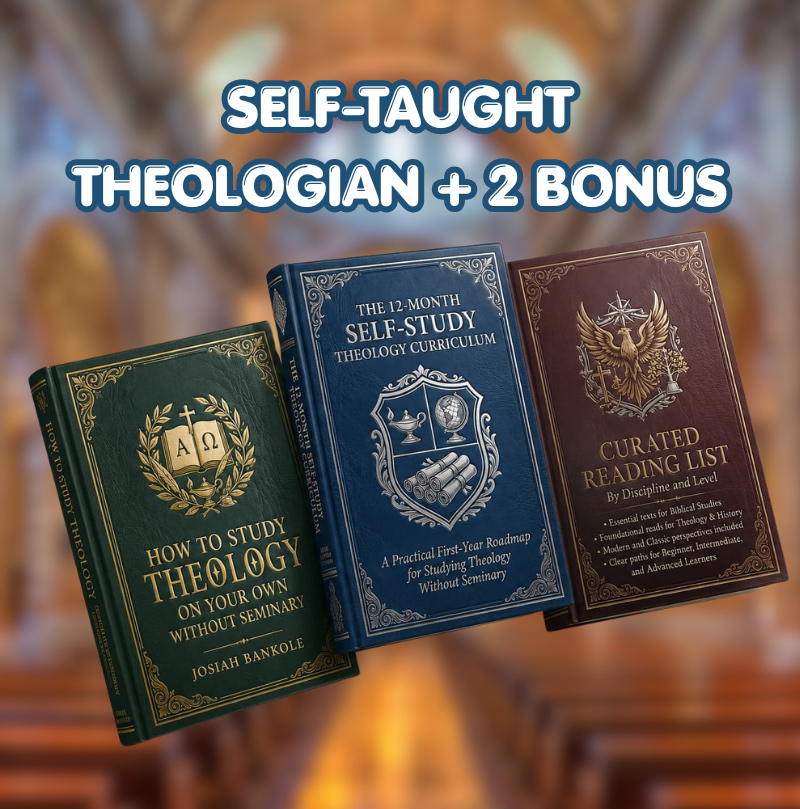
THE SELF-TAUGHT THEOLOGIAN: How to Study Theology on Your Own Without Seminary
You Don't Need a Seminary Degree to Understand the Bible Like a Trained Theologian
A complete, practical program for building your own theological education, at your own pace, without the tuition, the relocation, or the years away from your family and your income.
Grace had been attending church for eleven years. She led a weekly Bible study, mentored two younger women, and could out-argue most people on the doctrines she genuinely believed. But every time someone asked her a hard question, "why does God allow suffering," "what did Jesus really mean by that parable," "how do you know the Bible hasn't been changed," she felt a familiar tightness in her chest.
She wasn't unprepared because she didn't care. She was unprepared because she'd never had a plan. She'd read whatever crossed her path, whatever a pastor mentioned from the pulpit, whatever showed up on her timeline. It was a lot of information and almost no foundation.
Seminary crossed her mind more than once. Then reality crossed it right back out. Relocating wasn't an option. Neither was walking away from her job for two or three years. Neither was the tuition bill.
Here's what Grace didn't know yet: she didn't need the building. She needed the curriculum, the structure, and a plan she could actually follow around a full life, not instead of it.
That's exactly what this book gives you.
If any of this sounds familiar, this book was written for you:
- You want to understand the Bible and Christian doctrine deeply, not just casually, but formal theological education isn't realistic for your life right now, whether that's the cost, the distance, or the years it would take away from your family and income
- You've tried to "study theology on your own" before, bought a few books, watched a few sermons online, and eventually the effort fizzled out because there was no real plan behind it
- You're teaching, leading, or mentoring others already, and you privately feel like you're one hard question away from being exposed as unprepared
- You don't know where to even start: which books, in what order, at what pace, and how to tell a trustworthy source from a shallow one
- You're studying entirely alone, with no one to check your interpretations, which means you have no way of knowing if you've quietly drifted into a misreading
None of these are character flaws. They're structure problems. And structure problems have structural solutions.
WHAT READERS ARE SAYING
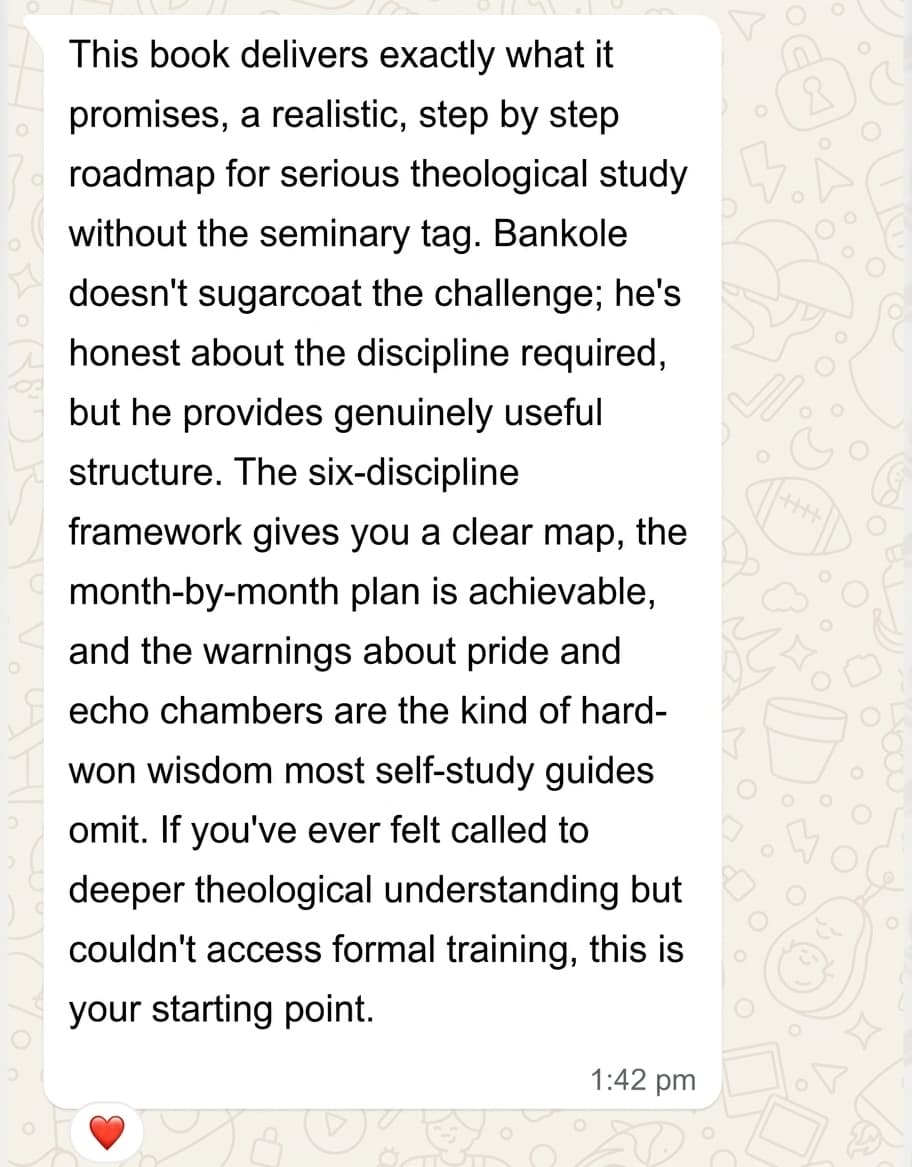
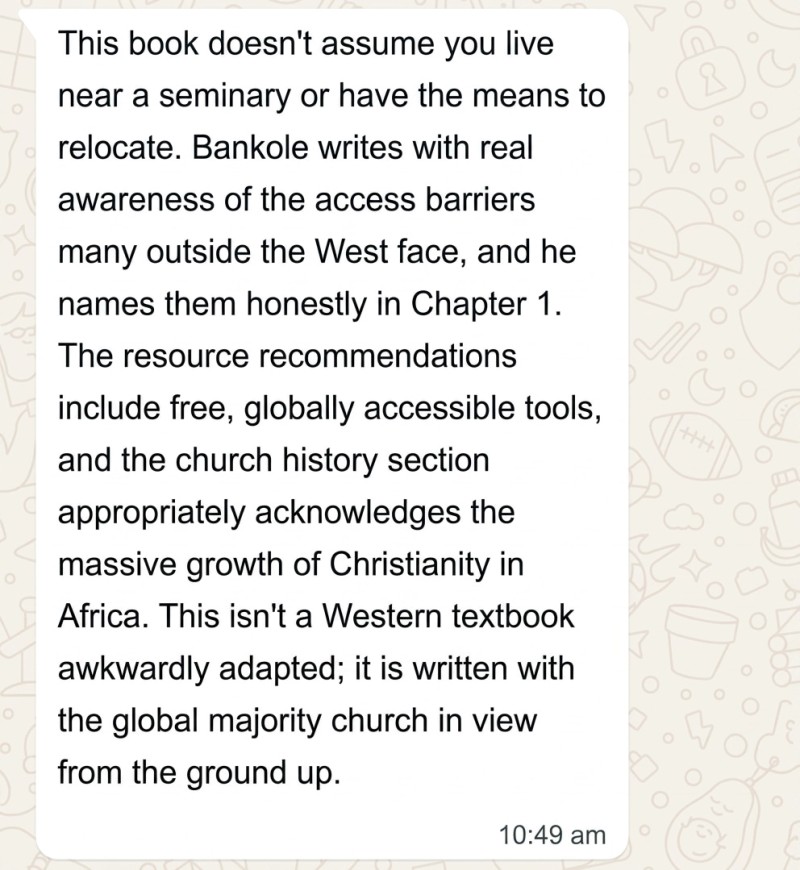
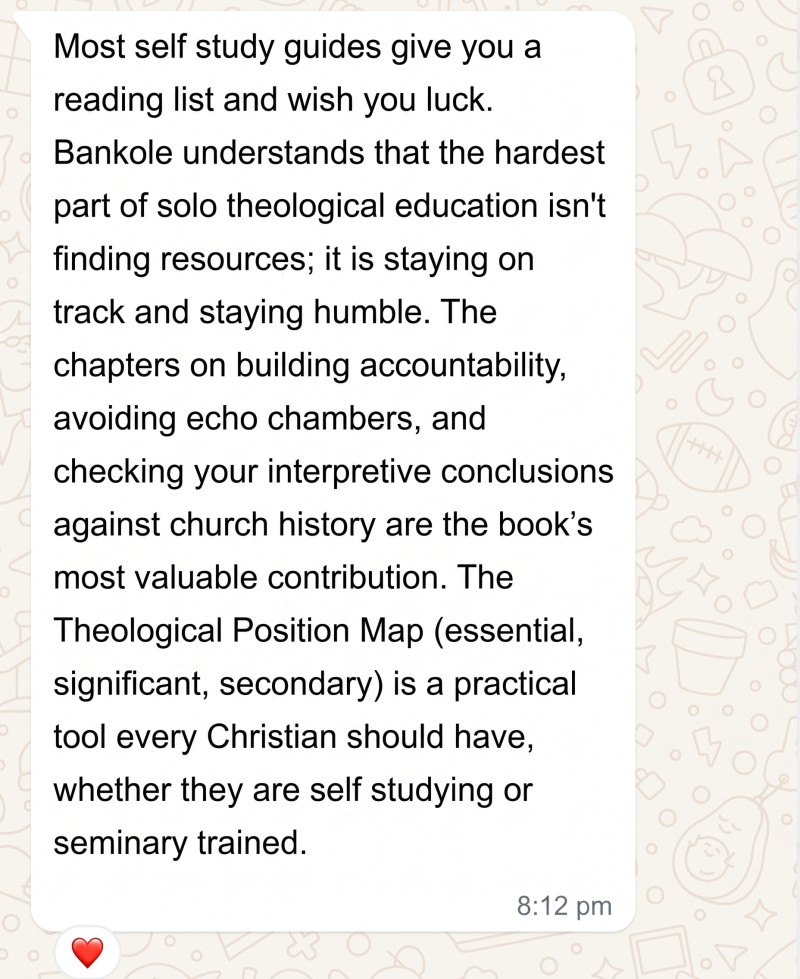
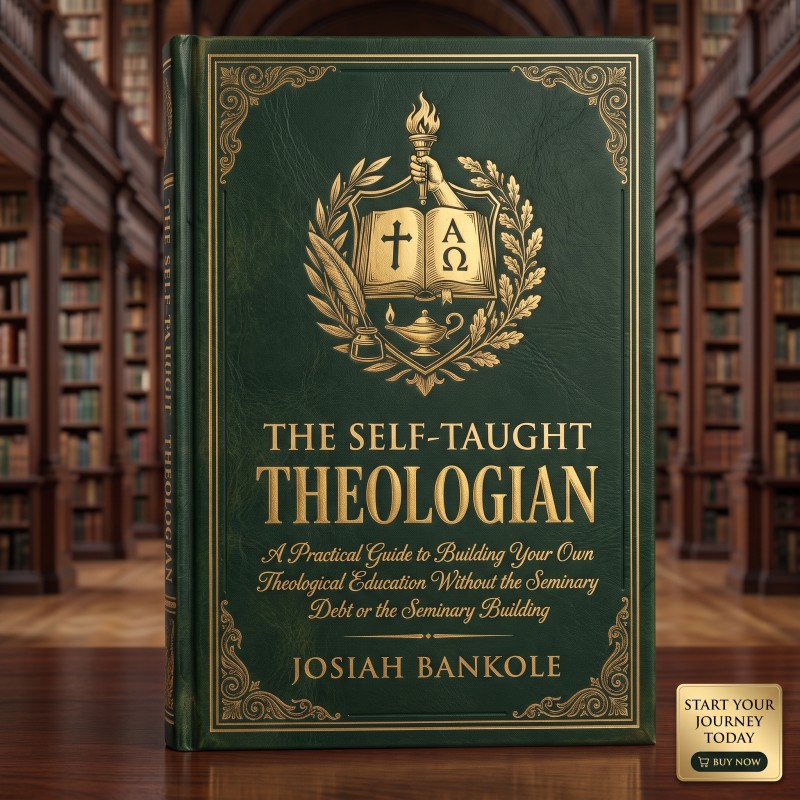
The Self-Taught Theologian is a complete, practical program for building real theological depth outside the seminary system, drawing on exactly what seminary curricula actually cover, reorganized into a self-study plan any serious, busy adult can follow.
This isn't a vague inspirational book about "loving God's Word more," and it isn't just something you read. Every chapter closes with a hands-on assignment, so you're actually doing the work, not just absorbing information. You'll get a repeatable framework for evaluating any theological source before you trust it, a map for understanding where Christian traditions agree and where they genuinely, faithfully differ, and a full graduation checklist to prove to yourself exactly what you've built by the end.
By the end, you'll have a concrete 24-month roadmap already built for you, ready to start this week, plus two free bonus guides to keep you moving.
WHAT'S INSIDE: THE FULL BREAKDOWN
Chapter 1: Why You Don't Need a Building to Become a Serious Student of God's Word What a seminary degree actually sells you, and which parts of it you can build yourself, starting now.
Chapter 2: What Seminary Actually Teaches The six core disciplines every real theological education covers, broken down so you know exactly what you're building toward.
Chapter 3: Building Your Own Curriculum How to turn those six disciplines into a realistic weekly and seasonal reading rhythm that fits your actual life, including the Source Test, a simple four-question framework for evaluating any book, sermon, or teacher before you trust them.
Chapter 4: The Non-Negotiable Foundation A concrete method for studying Scripture itself, translation choice, a repeatable interpretation method, and a realistic Bible read-through plan.
Chapter 5: Learning to Interpret Correctly The actual principles of sound biblical interpretation, so your conclusions come from the text, not from what you already wanted it to say.
Chapter 6: Systematic Theology Without a Classroom How to work through the major Christian doctrines in the right order, with the right cautions about tradition and bias built in.
Chapter 7: Church History and the Long Conversation Why two thousand years of Christian thought is one of the best safeguards a self-taught student has, and how to study it efficiently.
Chapter 8: Should You Learn Greek and Hebrew? An honest, no-guilt answer, with a clear decision framework instead of a one-size-fits-all "yes."
Chapter 9: Free and Low-Cost Resources That Replace Thousands in Tuition Real, named, currently available tools, seminary lecture archives, and platforms that cost nothing or next to nothing.
Chapter 10: Building Structure and Accountability Without a Classroom How to build the accountability a seminary classroom gives you automatically, even if you're starting with zero connections.
Chapter 11: Avoiding the Traps The five specific ways self-taught theological study quietly goes wrong, plus the Theological Position Map, a clear guide to which doctrines are essential, which are denominational, and which are secondary, so you never mistake a disagreement for heresy or a heresy for a minor difference.
Chapter 12: From Learning to Living How to turn private study into teaching, writing, mentoring, or ministry, starting small, starting now.
Chapter 13: Your Roadmap A complete, concrete 24-month, season-by-season study plan, pulling every chapter into one plan you can start this week, plus a full Graduation Checklist so you can see exactly what two years of real study actually built.
TWO FREE BONUSES INCLUDED
Bonus 1: Curated Reading List by Discipline and Level (included free)
A standalone companion guide with real, hyperlinked recommendations, beginner, intermediate, and advanced, for every one of the six disciplines, plus a full directory of free tools and resources. No guesswork about what to read next.
Bonus 2: The 12-Month Self-Study Theology Curriculum (included free)
Prefer to start smaller than a 24-month commitment? This is your first-year, month-by-month starting plan: what to read, what to practice, and what to write each month, with weekly rhythms, reflection questions, and a First-Year Theology Checkpoint to mark what you've actually learned. Once you finish it, Chapter 13's full 24-month roadmap is waiting to take you further.

WHO THIS IS FOR
- Believers who want real theological depth without a seminary budget or seminary timeline
- Bible study leaders and small group teachers who want to teach with genuine confidence
- Anyone who has started "studying theology" before and quietly given up without a plan
- Christians considering seminary later, who want a strong running start before they ever apply
- Writers, content creators, and aspiring teachers who want their material grounded in real study, not guesswork
WHO THIS IS NOT FOR
- Anyone looking for an accredited degree or ordination credential (this book is honest about that limit in Chapter 1)
- Anyone looking for a quick, no-effort shortcut. This is a real plan that takes real, sustained discipline. It's just a plan that doesn't require a campus.
ABOUT THE AUTHOR
Josiah Bankole is a self-taught student of Scripture and theology, writing for believers who want to go deeper in their faith without the cost or barriers of formal seminary education. This book is the resource he wished existed when he started.
FAQ
Do I need any prior Bible knowledge to start? No. Chapter 4 starts from the ground up with how to read and study Scripture itself before anything else.
How long will this take me to work through? The full roadmap in Chapter 13 is built around 24 months at 3 to 5 hours a week, but it's designed to flex around your schedule. There's no deadline. If 24 months feels like too big a first step, start with the free 12-Month Curriculum bonus instead, then move into the full roadmap once your first year is done.
Will this replace an actual seminary degree? No, and the book says so directly in Chapter 1. If you need formal ordination or an accredited credential, you need an institution. If you want real theological depth and the ability to teach, write, and answer hard questions with confidence, this book gets you there.
I've tried self-study before and gave up. Why would this be different? Because most self-study efforts fail from a missing plan, not missing willpower. This book gives you the exact plan, the sequence, the pacing, the resources, and the accountability structure, that most self-directed students never build for themselves. Every chapter also ends with a specific assignment, so you're never left wondering what to actually do next.
Is this just a book, or does it include exercises? Both. Each of the 13 chapters ends with a hands-on "Your Assignment" section, and the book includes practical frameworks you'll use repeatedly, like the Source Test for evaluating sources and the Theological Position Map for sorting doctrines by how essential they are.
You don't need permission to begin. You need a plan.
Get The Self-Taught Theologian now for launch price, plus two free bonus guides, and start your first week of study today.